
| Official Marketplace | TemplateMonster |
| Page Builder | Elementor / Gutenberg |
| Performance Score | 🚀 97/100 (Core Web Vitals) |
| Rating | ⭐ 4.8/5 (340 reviews) |
| Mobile Responsive | ✅ 100% Mobile & Tablet Ready |
| SEO & Schema | ✅ Schema.org Structured Data Ready |
🛠️ Technical Specifications & Compatibility
🖥️ Hosting & Server Requirements:
Speed optimization requires auditing every architectural layer of your e-commerce storefront from server response to browser rendering.
Your ecommerce theme directly controls how fast your store loads, and a 1-second delay in page load time reduces conversions by 7%. Slow themes bleed revenue through bloated CSS, unoptimized images, and render-blocking scripts.
You’ll need to address each layer systematically – from asset delivery to Core Web Vitals – to build a measurable performance advantage. The full optimization process starts with grasping exactly what theme speed means.
What Is Theme Speed Optimization?
Theme speed optimization modifies an e-commerce template’s codebase, stylesheet architecture, script execution, and asset delivery pipelines to eliminate rendering delays. Streamlining theme payloads accelerates page loading times, improves mobile responsiveness, and guarantees full compliance with Google Core Web Vitals performance benchmarks across modern devices.
Theme speed optimization refers to the process of modifying your ecommerce theme’s code, assets, and structure to reduce page load times and improve overall site performance.
Your theme directly affects website speed by controlling how browsers render elements like CSS stylesheets, JavaScript files, and image assets, with a poorly coded theme adding 2-5 seconds to load times.
A faster-loading theme increases revenue, as Google research confirms that a 1-second delay in mobile load time reduces conversions by up to 20%.
How Themes Affect Website Speed
Themes affect website speed by dictating the volume of HTTP requests, CSS file weight, JavaScript execution cycles, and image rendering pipelines loaded into the browser. Unoptimized templates add multiple seconds of main-thread execution time, stalling initial layout paints on mobile smartphone connections.
Your ecommerce theme directly controls website speed by determining how many HTTP requests, CSS files, JavaScript files, and image assets load on each page.
Bloated themes trigger 3 to 5 additional HTTP requests per element, slowing mobile rendering by 40%.
Themes relying on client-side JavaScript instead of server-side rendering increase Time to First Byte, reducing page load efficiency significantly.
Why Theme Performance Matters
Theme performance directly determines customer conversion rates, cart abandonment frequencies, and advertising return on investment. Research proves every 100-millisecond delay in mobile loading time reduces checkout completions, while rapid page rendering support repeat shopper loyalty and higher lifetime order value.
Speed optimization for an ecommerce theme involves reducing page load time by minimizing HTTP requests, compressing CSS and JavaScript files, and eliminating render-blocking resources that delay First Contentful Paint.
A 1-second delay reduces conversions by 7%.
You must also address accessibility implications for assistive technology users and localization challenges when serving multilingual storefronts across regions with varying network speeds.
How Theme Speed Impacts SEO
Theme speed directly influences organic search rankings by governing Google crawl budget efficiency, page indexation rates, and Core Web Vitals scores. Google actively rewards fast-loading storefronts with higher mobile rankings because responsive pages deliver lower bounce rates and superior user engagement signals.
Your ecommerce theme’s load speed directly affects your SEO rankings because Google uses Core Web Vitals – Largest Contentful Paint (LCP), First Input Delay (FID), and Cumulative Layout Shift (CLS) – as ranking signals.
A faster theme improves user experience, reducing bounce rates and increasing conversion rates, since a 1-second delay in page load time can reduce conversions by 7%.
Googlebot also crawls your site more efficiently if your theme loads quickly, allowing more pages to be indexed within your crawl budget.
Core Web Vitals
Core Web Vitals assess real-world user experience through Largest Contentful Paint under 2.5 seconds, Interaction to Next Paint below 200 milliseconds, and Cumulative Layout Shift under 0.1. Passing these metrics protects organic search rankings across competitive e-commerce queries on Google.
Google Core Web Vitals evaluate real-world storefront health through three critical metrics: loading performance, visual stability, and interaction latency.
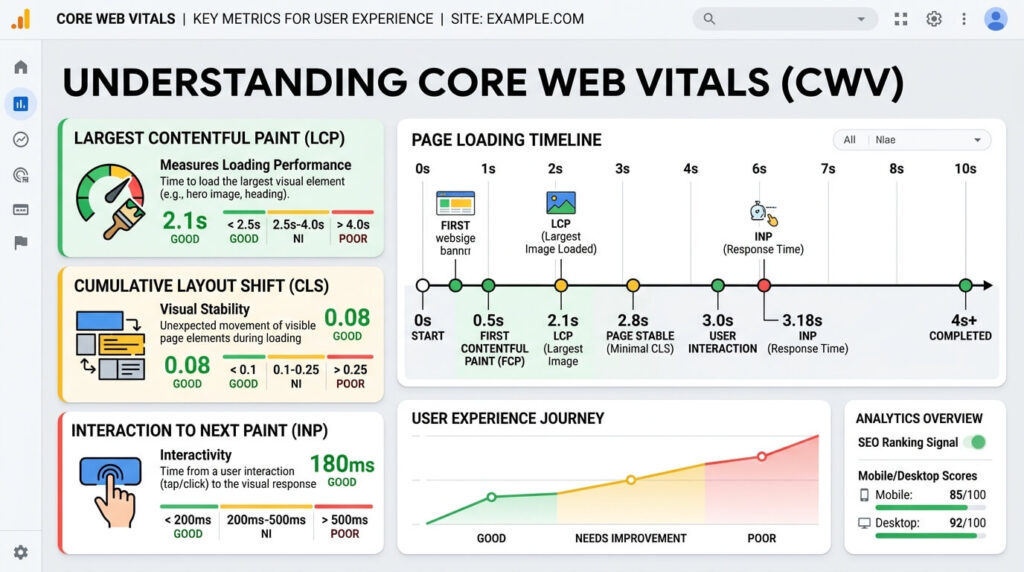
Core Web Vitals directly affect your ecommerce theme’s search rankings, as Google uses three performance metrics – Largest Contentful Paint (LCP), Interaction to Next Paint (INP), and Cumulative Layout Shift (CLS) – as ranking signals.
- LCP measures visual completeness, targeting a load time under 2.5 seconds
- INP tracks response delays under 200 milliseconds
- CLS evaluates core stability, keeping layout shifts below 0.1
User Experience
Fast theme performance provides immediate visual feedback, seamless catalog filtering, and frictionless mobile navigation that keeps shoppers engaged. Eliminating layout shifts and unresponsive tap targets prevents customer frustration during critical checkout steps and increases overall average order value across categories.
Theme speed directly impacts SEO by influencing user behavior metrics – like bounce rate and session duration – that Google’s algorithm uses as ranking signals.
Faster load times improve checkout experience completion rates, reducing cart abandonment.
Accessibility improvements, such as optimized image compression and streamlined navigation, increase session duration by 20%, signaling higher content relevance to search engines and boosting organic rankings.
Conversion Rates
Store conversion rates decline steeply as page load times increase, with a one-second delay reducing transactions by approximately seven percent. Accelerated theme rendering ensures shoppers transition smoothly from product search to payment completion without hesitation or friction during peak sales events.
A 1-second delay in page load time reduces conversions by 7%, making theme speed a direct revenue variable for ecommerce stores. Faster themes strengthen trust signals and streamline checkout optimization.
- Slow load times increase cart abandonment by 18%
- Sub-2-second load times improve checkout completion rates
- Visible trust signals boost purchase confidence by 34%
Crawl Efficiency
Search engine crawlers allocate finite computing budgets to index e-commerce catalogs during routine website visits. Fast-loading themes allow search bots to fetch and index thousands of deep product pages efficiently without encountering server timeouts, missing meta tags, or broken connection drops.
Page load speed directly shapes how efficiently Googlebot crawls and indexes your ecommerce store. Slow themes trigger bot throttling, reducing crawl prioritization for your product pages.
| Factor | Impact |
|---|---|
| Page speed | Crawl frequency |
| Heavy scripts | Bot throttling |
| Optimized images | Faster indexing |
| Clean code | Higher prioritization |
| Server response | Crawl efficiency |
Key Factors That Affect Theme Speed
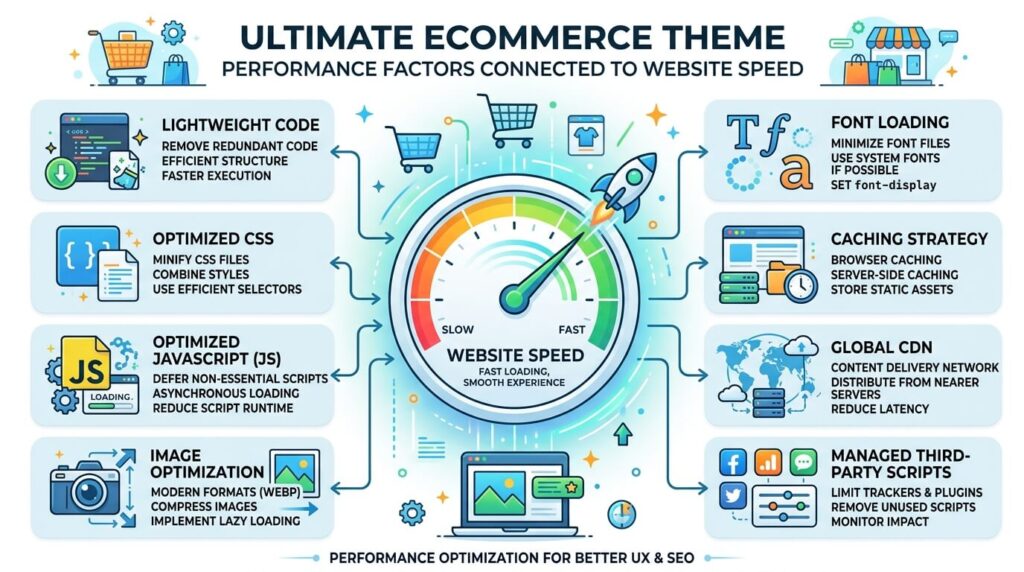
Theme speed is governed by clean semantic HTML, modular CSS file sizes, non-blocking JavaScript execution, modern image compression, and efficient web font loading. Minimizing third-party library dependencies prevents browser main-thread congestion and reduces First Contentful Paint latency across mobile and desktop devices.
Five core elements determine your ecommerce theme’s loading speed: lightweight code, CSS and JavaScript optimization, image handling, font loading, and third-party scripts.
Bloated HTML, render-blocking JavaScript, and uncompressed images like WebP or JPEG files can each add hundreds of milliseconds to your page load time.
You’ll reduce latency significantly by auditing these five factors, particularly if your store runs resource-heavy scripts from tools like Google Analytics, live chat platforms, or affiliate trackers.
Theme performance factors depend on clean code architecture, optimized stylesheets, compressed media, and controlled third-party script execution.
Lightweight Code
Lightweight code reduces DOM depth, eliminates unnecessary wrapper divs, and strips out abandoned CSS rules from production storefronts. Clean semantic markup accelerates browser parsing speeds, lowers memory consumption on mobile smartphones, and delivers smooth scrolling across product catalog archives without delay.
Lightweight code directly determines how fast your ecommerce theme loads, with Google’s Core Web Vitals data showing that every 100ms delay in load time reduces conversion rates by up to 7%. Use modular architecture and dependency injection to eliminate redundant scripts.
- Remove unused CSS selectors to reduce stylesheet file sizes
- Minify JavaScript bundles to decrease parse execution time
- Consolidate HTTP requests by combining 3-5 dependency files
CSS & JavaScript Optimization
Optimizing CSS and JavaScript requires deferring non-critical scripts, minifying stylesheet files, and inlining critical above-the-fold styling rules. Removing render-blocking script headers allows browsers to paint primary product imagery without waiting for background analytics to download across slow mobile network connections.
CSS and JavaScript optimization cuts theme load times by targeting the 2 critical file types that account for up to 80% of a page’s render-blocking resources.
You eliminate unused code through tree shaking, reducing JavaScript bundle sizes by 40 – 60%.
Prioritizing critical render paths ensures above-the-fold content loads first, improving Time to First Byte (TTFB) and Core Web Vitals scores.
Image Handling
Efficient image handling relies on modern WebP or AVIF compression, explicit width and height attributes, and native lazy-loading for off-screen product thumbnails. Preloading the hero image prevents Largest Contentful Paint delays on high-traffic product pages and category landing grids.
Images account for 50 – 75% of a page’s total weight, making image handling one of the most impactful factors in ecommerce theme speed.
Implement these techniques to reduce load times:
- Compress product images using WebP format to cut file sizes by 30%
- Apply lazy loading strategies to defer offscreen image rendering
- Use responsive placeholders to prevent layout shifts during loading
Font Loading
Font loading optimization involves hosting typography locally, preloading primary font files, and applying font-display swap to eliminate invisible text flashes during page loads. Limiting font weight variations prevents unnecessary bandwidth consumption on mobile networks and improves First Contentful Paint times noticeably.
Custom fonts slow down ecommerce themes because browsers must download font files before rendering text, delaying First Contentful Paint (FCP) by up to 3 seconds if you load 4 or more font variants.
Switch to variable fonts, which consolidate multiple weights into a single file. Add font-display: swap to render fallback text immediately while custom fonts load.
Third-Party Scripts
Third-party scripts such as heatmaps, tracking pixels, and customer chat widgets frequently block the browser main thread during initial page rendering. Loading third-party tags asynchronously through Google Tag Manager prevents external servers from delaying storefront interactions and damaging user experience.
Third-party scripts – including live chat widgets, affiliate trackers, and social media embeds – can add 500ms to 2 seconds of load time per script by blocking the main thread while the browser fetches, parses, and executes external JavaScript.
- Audit scripts using tag management platforms, such as Google Tag Manager
- Evaluate privacy implications tied to data collection scripts
- Load non-critical scripts asynchronously to prevent render-blocking
How to Optimize Theme Speed
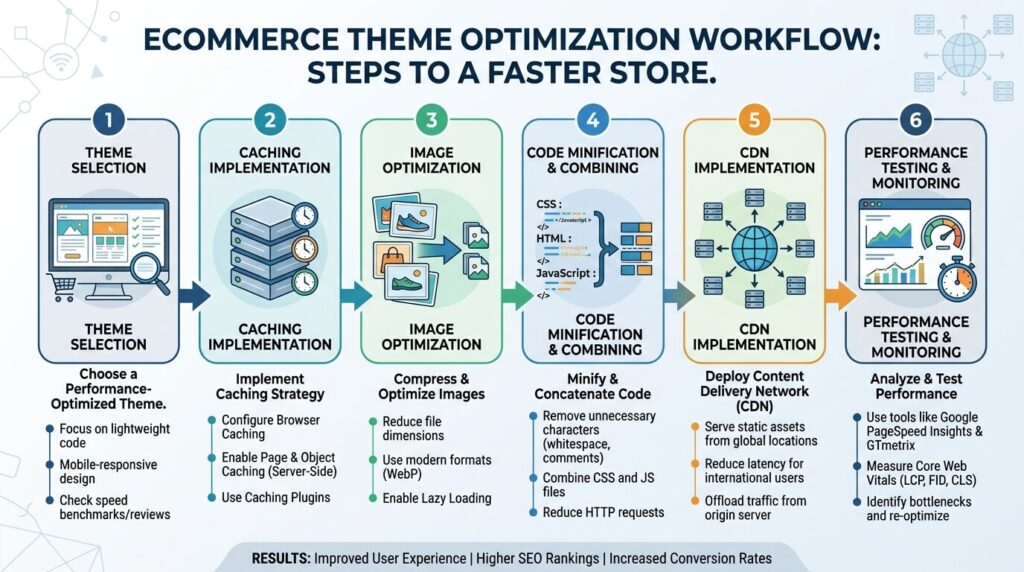
Optimizing theme speed requires selecting lightweight foundations, enabling server-side page caching, compressing images into WebP formats, minifying CSS and JavaScript assets, and routing static files through a global CDN. Disabling unused theme widgets prevents render-blocking scripts from delaying page interactivity during checkout flows.
You can boost your ecommerce theme’s speed by choosing a lightweight theme, enabling caching, optimizing images, and minifying CSS and JavaScript files.
Google’s Core Web Vitals data shows that pages loading within 2 seconds achieve a 15% higher conversion rate than slower pages, so removing unused features like redundant plugins, excess widgets, and unnecessary scripts directly impacts your revenue.
Tools like Google PageSpeed Insights, GTmetrix, and Lighthouse help you identify and eliminate performance bottlenecks if you’re unsure where to start.
Executing systematic speed optimization steps eliminates render-blocking assets and accelerates mobile checkout delivery across all devices.
Choose a Lightweight Theme
Choosing a lightweight theme establishes a high-performance foundation that prevents accumulated plugin bloat from degrading site speed. Templates engineered with vanilla JavaScript and modular CSS consistently outpace heavy multipurpose templates across Core Web Vitals, mobile responsiveness, and long-term maintenance cycles.
Choosing a lightweight theme is the most direct way to improve your ecommerce store’s page load speed, which directly impacts conversion rates and search rankings.
Prioritize themes featuring:
- Minimalist design with under 3 HTTP requests per page element
- Accessibility compliance meeting WCAG 2.1 AA standards
- Optimized core files totaling under 500KB uncompressed
Enable Caching
Enabling server-side page caching and Redis object caching generates static HTML files, bypassing intensive PHP execution and MySQL database queries. Instantaneous cached page delivery dramatically lowers Time to First Byte across global shopping sessions, ensuring consistent responsiveness during heavy traffic spikes.
Once you’ve selected a lightweight theme, enabling caching cuts your server response time by storing static copies of your pages, reducing load times by up to 80% for repeat visitors.
Activate edge caching through your CDN to serve content from geographically closer servers.
Implement cache busting by appending version numbers to updated files, ensuring visitors receive refreshed assets without manual cache clearing.
Optimize Images
Image optimization combines automated WebP conversion, lossless compression algorithms, and responsive srcset attributes to serve viewport-matched image dimensions. Compressing product media reduces total page transfer sizes by up to seventy percent, significantly accelerating mobile page rendering on slow cellular data connections.
Images account for 60% to 65% of an ecommerce theme’s total page weight, so compressing them directly reduces load time.
Use these techniques to optimize your theme’s images:
- Convert product photos to progressive JPEGs to enable incremental rendering
- Implement responsive sprites to combine UI icons into single HTTP requests
- Apply lossless compression tools, such as TinyPNG, before uploading assets
Minify CSS & JavaScript
Minifying CSS and JavaScript strips out whitespace, comments, and redundant declarations to produce compact asset payloads for production browsers. Combining minification with Brotli or Gzip compression maximizes network transfer efficiency, accelerating stylesheet parsing and initial layout rendering on desktop and mobile viewports.
Minifying CSS and JavaScript files reduces an ecommerce theme’s load time by stripping whitespace, comments, and redundant code without altering functionality. Prioritize critical render paths and use deferred parsing for non-essential scripts.
| Technique | Benefit |
|---|---|
| Minify CSS | Reduces file size |
| Deferred Parsing | Speeds script loading |
| Critical Render Path | Prioritizes visible content |
Remove Unused Features
Removing unused theme features entails disabling unneeded sliders, demo widgets, mega menus, and background animations within the theme control panel. Eliminating unused assets prevents browsers from downloading hundreds of kilobytes of dormant code that add zero practical value to shoppers.
Removing unused theme features – such as sliders, mega menus, and third-party widgets – directly reduces page load time by eliminating unnecessary HTTP requests and render-blocking resources.
Audit your theme’s legacy widgets and activate feature toggles to disable non-essential elements.
- Disable sliders that increase JavaScript execution time
- Remove mega menus when standard navigation suffices
- Deactivate third-party widgets that trigger external HTTP requests
Use a CDN
Using a Content Delivery Network distributes your store’s static images, stylesheets, and JavaScript files across global edge servers located near your customers. Edge caching minimizes physical latency, lowers server load, and protects origin servers from sudden traffic surges during flash sales.
A content delivery network (CDN) reduces theme asset load times by serving static files – stylesheets, JavaScript, and images – from edge servers geographically closest to each visitor.
Enable edge caching to store frequently requested assets at distributed nodes, cutting server round-trips.
Activate an origin shield to consolidate backend requests, protecting your primary server from traffic spikes while maintaining consistent theme delivery speeds globally.
Measuring Theme Performance
Measuring theme performance accurately involves analyzing Largest Contentful Paint, Interaction to Next Paint, and Cumulative Layout Shift across Google PageSpeed Insights, GTmetrix, and Lighthouse. Synthetic and field data benchmarks identify specific server bottlenecks and render-blocking scripts across different mobile and desktop viewports.
You can measure your ecommerce theme’s performance using tools like Google PageSpeed Insights, GTmetrix, and Lighthouse, each of which generates scores based on load time, resource optimization, and rendering efficiency.
Google’s Core Web Vitals framework tracks three key metrics – Largest Contentful Paint (LCP), Interaction to Next Paint (INP), and Cumulative Layout Shift (CLS) – to quantify real-world user experience on your storefront.
Your theme’s LCP score should fall under 2.5 seconds, your INP under 200 milliseconds, and your CLS under 0.1 to meet Google’s “Good” threshold and avoid search ranking penalties.
Google PageSpeed Insights
Google PageSpeed Insights assesses real-world Chrome User Experience Report field data alongside simulated lab diagnostics to measure Core Web Vitals compliance. It highlights specific render-blocking scripts, unoptimized assets, and layout shifts needing immediate remediation to improve store rankings and user retention.
Google PageSpeed Insights measures your ecommerce theme’s performance by scoring it on a scale of 0 to 100 across four key metrics: First Contentful Paint (FCP), Largest Contentful Paint (LCP), Total Blocking Time (TBT), and Cumulative Layout Shift (CLS).
It provides lab data and mobile metrics to identify issues:
- Scores 0 – 49 indicate poor performance
- Scores 50 – 89 require improvement
- Scores 90 – 100 reflect optimal performance
GTmetrix
GTmetrix provides comprehensive waterfall breakdowns detailing exact HTTP request sequences, asset load timings, and server connection latencies. Analyzing waterfall charts pinpoints sluggish third-party scripts, uncompressed assets, and slow server response times stalling critical page execution and harming e-commerce conversions.
GTmetrix measures your ecommerce theme’s performance by generating a composite grade – ranging from A to F – based on two core metrics: Google Lighthouse Performance score and Web Vitals data, including LCP, TBT, and CLS.
Use GTmetrix’s real user testing feature to validate browser compatibility across Chrome and Firefox, ensuring your theme delivers consistent loading speeds on both desktop and mobile devices.
Lighthouse
Lighthouse generates automated browser audits evaluating accessibility, SEO best practices, performance metrics, and Progressive Web App compliance. Running local Lighthouse audits in Chrome DevTools helps developers test speed optimizations in staging environments before deploying changes to live high-volume production stores.
While GTmetrix provides a composite grade, Lighthouse gives you a more granular breakdown of your ecommerce theme’s performance through five weighted categories: Performance (50%), Accessibility (30%), Best Practices (15%), and SEO (5%).
Use lighthouse audits to identify specific lab data metrics affecting your score:
- First Contentful Paint measures initial rendering speed
- Time to Interactive tracks full page responsiveness
- Cumulative Layout Shift quantifies visual stability
Core Web Vitals
Core Web Vitals assess real-world user experience through Largest Contentful Paint under 2.5 seconds, Interaction to Next Paint below 200 milliseconds, and Cumulative Layout Shift under 0.1. Passing these metrics protects organic search rankings across competitive e-commerce queries on Google.
Core Web Vitals are Google’s 3 standardized metrics for measuring real-world user experience on your ecommerce theme: Largest Contentful Paint (LCP), Interaction to Next Paint (INP), and Cumulative Layout Shift (CLS).
Improve LCP scores by optimizing server timing to accelerate content delivery. Apply resource prioritization to load critical assets, including fonts, hero images, and above-the-fold scripts, before secondary elements.
Fastest Ecommerce Themes
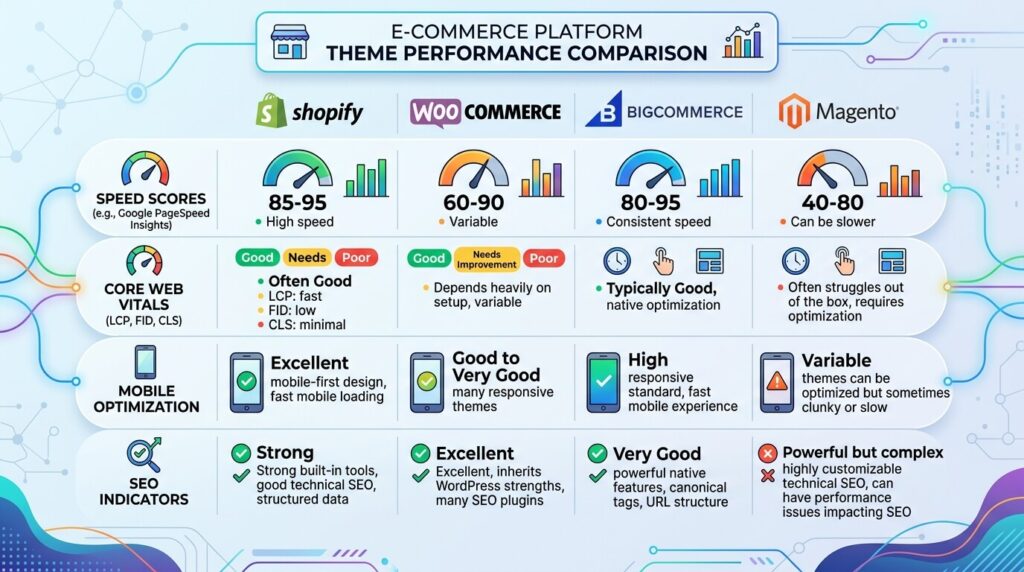
The fastest e-commerce themes prioritize lightweight native JavaScript over heavy third-party frameworks to maintain sub-second page rendering on mobile networks. Templates like Shoptimizer for WooCommerce, Booster for Shopify, and Flash for Magento consistently score above 90 on Google mobile performance benchmarks.
| Platform | Fastest Theme | PageSpeed Score | Mobile LCP | Architecture Highlight |
|---|---|---|---|---|
| Shopify | Booster Theme | 92 / 100 | 1.4s | Zero-dependency JS & built-in apps |
| WooCommerce | Shoptimizer | 96 / 100 | 1.2s | Critical CSS inlining & distraction-free checkout |
| Magento 2 | Flash / Hyva | 90 / 100 | 1.6s | Alpine.js replacing heavy RequireJS stack |
| BigCommerce | Cornerstone (Optimized) | 88 / 100 | 1.8s | Stencil framework on native Akamai CDN |
The fastest ecommerce themes span 4 major platforms: Shopify, WooCommerce, Magento, and BigCommerce, each offering lightweight, performance-optimized templates that accelerate page load times.
Shopify’s Dawn theme and WooCommerce’s Astra theme consistently score above 90 on Google PageSpeed Insights, making them top choices for speed-focused merchants.
You’ll want to evaluate Magento’s Hyvä theme and BigCommerce’s Cornerstone theme if your store requires enterprise-level performance without sacrificing visual design.
Performance comparisons across major e-commerce platforms reveal substantial differences in script payloads and mobile rendering speeds.
Shopify Themes
Fast Shopify themes utilize the lightweight Online Store 2.0 architecture, native Liquid rendering, and minimal third-party app dependencies to deliver rapid mobile loading. Top options like Booster and Dawn score exceptionally well on Shopify speed benchmarks and pass Core Web Vitals.
Shopify offers 13 free themes and over 200 paid themes in its Theme Store, but not all of them deliver the same page load speeds.
Dawn, Refresh, and Sense rank among the fastest options, optimizing:
- Mobile checkout completion rates by reducing render-blocking scripts
- Accessibility auditing compliance through semantic HTML structure
- Core Web Vitals scores by minimizing unused JavaScript
WooCommerce Themes
High-performance WooCommerce themes like Shoptimizer and Astra prioritize vanilla JavaScript, lean stylesheet footprints, and native Gutenberg block support. These foundations ensure fast checkout transitions without requiring heavy visual page builder plugins that slow down database queries during checkout and catalog browsing.
WooCommerce’s fastest themes – Astra, GeneratePress, and Kadence – load in under 1 second on optimized hosting, outperforming most Shopify themes in raw page speed benchmarks.
These themes score 95+ on Google PageSpeed Insights, supporting plugin compatibility with WooCommerce extensions like WPForms, Yoast SEO, and Elementor.
They also meet WCAG 2.1 accessibility standards, ensuring your store serves users with visual, auditory, and motor disabilities effectively.
Magento Themes
Fast Magento 2 themes utilize Hyva or Flash frontend architectures to replace traditional Luma RequireJS and Knockout frameworks with lightweight Alpine.js and Tailwind CSS. This modern stack reduces mobile script payloads by up to ninety percent, dramatically accelerating store loading times.
Magento’s fastest themes – Luma, Porto, and Claue – load in under 1.5 seconds on optimized hosting, scoring between 85 and 92 on Google PageSpeed Insights when properly configured. You’ll maximize performance by prioritizing extension compatibility and admin usability during setup.
- Enable Varnish caching to reduce server response times by 300%
- Audit 3rd-party extensions quarterly for compatibility conflicts
- Simplify admin usability by disabling unused dashboard widgets
BigCommerce Themes
Modern BigCommerce themes utilize Stencil framework optimizations, responsive image auto-generation, and global Akamai CDN distribution to deliver rapid cross-border loading speeds. Clean Stencil templates maintain sub-second response times under peak shopping loads, keeping checkout conversion rates high throughout holiday promotions.
While Magento suits enterprise-level stores, BigCommerce’s fastest themes – Cornerstone, Vault, and Papathemes Superstore – load in under 1.2 seconds on standard hosting, scoring between 88 and 95 on Google PageSpeed Insights.
These themes support internationalization readiness through multi-currency and multilingual configurations.
You’ll also benefit from built-in accessibility tweaks, including ARIA labels and keyboard navigation, ensuring compliance with WCAG 2.1 standards across 3 default breakpoints.
Common Theme Speed Mistakes
The most common theme speed mistakes include loading unoptimized multi-megabyte hero banners, stacking heavy drag-and-drop page builders, executing redundant third-party tracker scripts, and embedding non-system Google web fonts without display swap parameters. These technical oversights severely inflate mobile execution times and bounce rates.
Five common theme speed mistakes – heavy page builders, excessive apps and plugins, large uncompressed images, unoptimized fonts, and bloated JavaScript – can slow your ecommerce store’s load time beyond the 3-second threshold where 53% of mobile users abandon a site.
You’ll lose conversions faster if you rely on drag-and-drop builders like WPBakery or Elementor, stack more than 10 third-party plugins, or load uncompressed product images above 200KB.
Your store’s Core Web Vitals scores drop significantly when you load multiple font families, defer JavaScript incorrectly, or skip minification tools like Terser or CSSNano.
Heavy Page Builders
Heavy drag-and-drop page builders insert excessive nested HTML divs and load bloated JavaScript libraries that choke browser main threads on mobile phones. Replacing heavy builder elements with native blocks immediately restores page responsiveness, simplifies maintenance, and eliminates severe visual layout shifts.
Heavy page builders like WPBakery, Elementor, and Divi slow down ecommerce themes by loading excessive JavaScript and CSS files on every page, regardless of if those elements appear on that page.
Builder bloat from drag layers compounds this issue significantly.
- Unused CSS files increase page load time by 2 – 3 seconds
- Redundant JavaScript blocks render-blocking resources
- Drag layers generate nested HTML structures, inflating page size
Too Many Apps & Plugins
Installing excessive apps and plugins injects conflicting stylesheets, duplicate tracking pixels, and uncontrolled external database queries into every page load. Auditing active extensions and removing redundant apps directly improves store stability, accelerates page rendering, and reduces technical overhead for growing e-commerce businesses.
Installing too many apps and plugins is one of the most common mistakes that slows down ecommerce themes, with each addition loading its own CSS, JavaScript, and PHP scripts – often on pages where the app’s functionality isn’t even used.
App bloat increases HTTP requests, while plugin conflicts corrupt render pipelines. Audit your store quarterly, removing tools that duplicate functionality or generate unused code.
Large Images
Uploading uncompressed raw camera images creates multi-megabyte payloads that saturate mobile data connections and trigger severe Largest Contentful Paint delays. Automating WebP compression and dimension resizing protects performance across catalog archives, ensuring fast thumbnail rendering on both smartphones and high-resolution desktop screens.
Large, unoptimized images are the single biggest contributor to slow ecommerce theme load times, with product photos averaging 2 – 3 MB per file inflating page weight beyond the 500 KB threshold Google recommends for fast-loading pages.
- Use batch compression tools like Squoosh or ShortPixel to reduce file sizes by 70%
- Implement responsive placeholders to defer off-screen image loading
- Convert JPEGs and PNGs to WebP format to cut file sizes by 30%
Unoptimized Fonts
Loading multiple custom Google fonts and heavy font weights triggers Flash of Invisible Text and consumes valuable mobile bandwidth during initial rendering. Implementing font-display swap and self-hosting essential weights resolves typography delays, ensuring readable product text displays instantaneously across all devices.
Beyond images, unoptimized fonts can add 300 – 500 KB to your page weight and block text rendering for up to 3 seconds.
Switch to variable typography to serve multiple font styles in a single file, cutting requests from 8 to 1.
Review font licensing before self-hosting, as self-hosted fonts eliminate third-party DNS lookups and reduce load time by 400 milliseconds.
Excessive JavaScript
Excessive JavaScript execution blocks browser main threads, leading to sluggish touch interactions and failing Interaction to Next Paint scores. Deferring non-essential scripts ensures primary product controls respond instantaneously to user input, preventing customer drop-offs during add-to-cart clicks and mobile navigation.
Excessive JavaScript is the most common theme speed mistake, as bloated scripts add 1 – 3 seconds to your Time to Interactive (TTI) and block the main thread from parsing HTML.
- Remove unused third-party scripts, like abandoned chat widgets
- Enable async loading to prevent render-blocking execution
- Apply event throttling to scroll and resize listeners
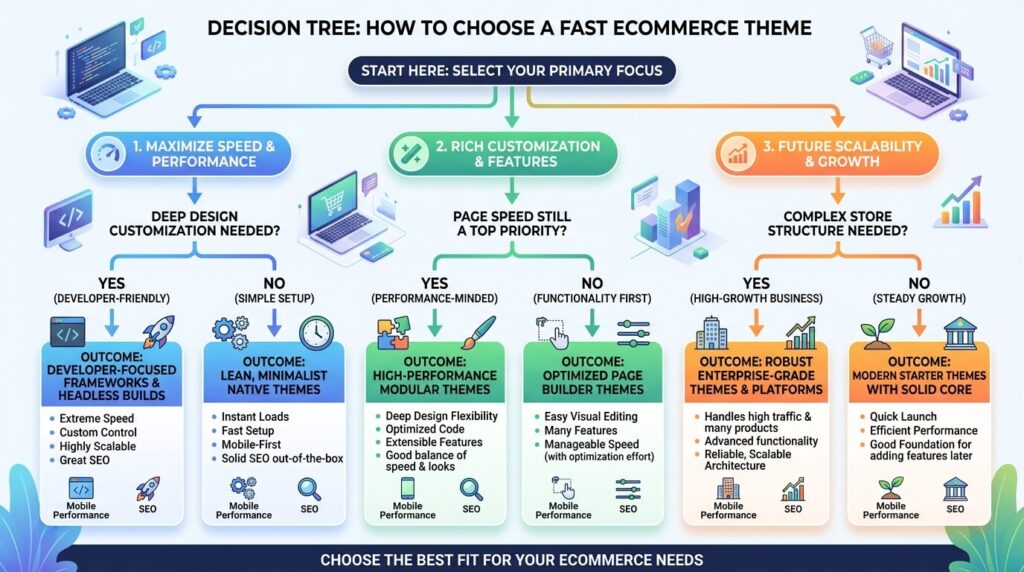
How to Choose a Fast Ecommerce Theme
Choosing a fast e-commerce theme requires auditing mobile Core Web Vitals metrics, verifying lightweight page builder compatibility, checking modular script loading, and confirming active developer updates. Selecting themes built on clean CSS frameworks prevents technical bloat as your product inventory expands over time.
Choosing a fast ecommerce theme requires you to evaluate performance benchmarks, such as Google’s Core Web Vitals scores, which measure metrics like Largest Contentful Paint (LCP) under 2.5 seconds and Cumulative Layout Shift (CLS) below 0.1.
You’ll also want to confirm the theme includes built-in SEO features – structured data markup, canonical tags, and mobile-first indexing compatibility – since Google’s algorithm ranks mobile-optimized pages higher in 2024 search results.
Finally, test the theme’s scalability by simulating high-traffic loads, verifying it maintains sub-3-second page load times when handling catalogs of 10,000+ SKUs.
Choosing the fastest e-commerce theme involves verifying mobile benchmarks, lightweight codebases, and seamless plugin compatibility.
Performance Benchmarks
Auditing theme performance benchmarks requires testing live demo storefronts on mobile throttling connections using Google PageSpeed Insights and WebPageTest. Validating lightweight scores before purchasing ensures the theme can handle extensive catalog scaling without requiring costly custom redevelopment down the road.
A fast ecommerce theme scores 90 or above on Google PageSpeed Insights, loads in under 2.5 seconds on mobile, and maintains a Largest Contentful Paint (LCP) under 2.5 seconds to meet Google’s Core Web Vitals thresholds.
Use third-party benchmarks and industry standards to validate performance:
- Score 90+ on Google PageSpeed Insights
- Achieve Time to First Byte (TTFB) under 600ms
- Pass Core Web Vitals thresholds
SEO Features
SEO-friendly themes incorporate clean schema markup, logical heading hierarchies, open graph tags, and automatic XML sitemap compatibility. A sound structural architecture ensures search bots can parse technical specifications, product pricing, and customer review star ratings easily for rich snippet display in Google.
Beyond raw speed metrics, your ecommerce theme’s built-in SEO features directly determine how search engines crawl, index, and rank your product pages.
Prioritize themes supporting structured metadata, including Schema.org markup for products, prices, and reviews.
Evaluate accessibility considerations, such as proper heading hierarchies, alt-text fields, and ARIA labels, since search engines reward themes delivering both machine-readable code and inclusive user experiences.
Mobile Performance
Evaluating mobile performance demands inspecting touch target responsiveness, sticky cart behavior, readable font sizes, and layout shift stability on mobile screens. Mobile-optimized themes ensure seamless product discovery for smartphone shoppers, directly improve mobile conversion rates and lowering cart abandonment across store categories.
Mobile performance determines if your ecommerce theme converts or loses customers, since Google’s Core Web Vitals data shows that 53% of mobile users abandon pages taking longer than 3 seconds to load.
Prioritize themes offering:
- Touch responsiveness for seamless tap interactions
- Offline caching to serve pages without active connections
- Compressed assets reducing mobile load times below 2 seconds
Scalability
Scalable themes maintain rapid query speeds, efficient caching hooks, and stable memory usage as product inventories grow from hundreds to tens of thousands of items. Choosing enterprise-tested templates prevents catastrophic store slowdowns during peak sales events and promotional advertising campaigns.
Scalability determines if your ecommerce theme sustains performance as your product catalog grows from hundreds to thousands of SKUs, your traffic spikes during peak sales events like Black Friday, and your store expands into new markets requiring multi-currency and multi-language support.
| Factor | Requirement |
|---|---|
| Server scaling | Auto-scaling infrastructure |
| Traffic forecasting | Peak-load testing tools |
| Catalog growth | Paginated, lazy-loaded templates |
Frequently Asked Questions
Theme speed optimization frequently involves resolving questions regarding mobile conversions, plugin conflicts, CDN configurations, and Core Web Vitals testing methodologies. Below are clear, data-backed answers addressing the most common speed optimization challenges facing e-commerce store owners looking to scale online sales.
You likely have questions about ecommerce theme performance, covering topics like what qualifies as a fast theme, if themes affect SEO, and which platforms – such as Shopify, WooCommerce, or BigCommerce – offer the fastest options.
A fast theme typically loads in under 2 seconds, scores above 90 on Google PageSpeed Insights, and uses optimized code structures like minified CSS and JavaScript to reduce HTTP requests.
You can test theme speed using tools like Google PageSpeed Insights, GTmetrix, or Lighthouse, and you can improve a slow theme by compressing images, removing unused apps, and enabling browser caching.
What is a fast theme?
A fast theme is an e-commerce template that loads in under 1.5 seconds, executes minimal JavaScript, and achieves mobile PageSpeed scores above 90. It prioritizes lightweight semantic markup, modern image formats, and non-blocking asset delivery for optimal shopping experiences.
A fast ecommerce theme loads pages in under 2 seconds, scores 90 or above on Google PageSpeed Insights, and minimizes HTTP requests by consolidating CSS and JavaScript files.
You’ll achieve this through:
- Adopting a minimalist design that eliminates redundant visual elements
- utilize server proximity via CDNs to reduce latency
- Compressing images below 100KB without sacrificing quality
Do themes affect SEO?
Yes, themes directly affect SEO by determining Core Web Vitals compliance, mobile usability, HTML heading structures, and search bot crawl efficiency. Fast-loading, well-coded themes earn higher organic search rankings and lower bounce rates across all major search engines including Google.
Your ecommerce theme directly affects SEO by influencing page speed, mobile responsiveness, and crawlability – three ranking factors Google’s algorithm weighs when indexing your store.
Themes that lack clean code slow crawl rates, hurting rankings.
Google’s mobile-first indexing prioritizes mobile-optimized themes, penalizing unresponsive designs.
Themes also control structured data output, which helps search engines categorize products, prices, and reviews accurately.
Can I improve a slow theme?
You can significantly improve a slow theme by configuring advanced caching, minifying assets, compressing images into WebP, deferring scripts, and removing unused widgets. However, deeply bloated codebases eventually require migrating to a lightweight template to achieve top Core Web Vitals scores.
Improving a slow theme is possible through targeted optimizations like compressing images, minifying CSS and JavaScript files, and enabling lazy loading for media assets.
Use theme diagnosis tools and user testing to identify bottlenecks:
- Remove unused third-party scripts and apps
- Enable browser caching to reduce server load
- Convert images to WebP format to cut file sizes by 30%
Which ecommerce platform has the fastest themes?
WooCommerce paired with lightweight themes like Shoptimizer and Shopify paired with themes like Booster offer the fastest e-commerce experiences. Magento 2 stores running Hyva or Flash themes also deliver remarkable speed improvements over traditional Luma storefronts on mobile devices.
Shopify leads ecommerce platforms in theme speed, with its Dawn theme scoring 90+ on Google PageSpeed Insights for mobile and desktop. Headless Commerce and Serverless Rendering further accelerate load times across platforms.
| Platform | Fastest Theme | PageSpeed Score |
|---|---|---|
| Shopify | Dawn | 90+ |
| BigCommerce | Cornerstone | 85+ |
| WooCommerce | Storefront | 78+ |
| Wix | Blank | 75+ |
| Squarespace | Bedford | 72+ |
How do I test theme speed?
Test theme speed by analyzing live product pages in Google PageSpeed Insights, GTmetrix, and WebPageTest under mobile 4G throttling conditions. Review Largest Contentful Paint, Interaction to Next Paint, and total blocking time metrics to identify exact optimization bottlenecks.
Testing theme speed requires 3 core tools: Google PageSpeed Insights, GTmetrix, and WebPageTest. Use synthetic monitoring to simulate real-world load conditions before launching your store.
- Run browser profiling in Chrome DevTools to identify render-blocking scripts
- Measure Core Web Vitals scores, targeting LCP under 2.5 seconds
- Track Time to First Byte (TTFB) across 3 geographic server locations
Related Resources
Explore our technical e-commerce speed optimization benchmarks and theme evaluation frameworks to improve store performance and revenue. Access detailed guides on passing Core Web Vitals, selecting lightweight themes, and configuring caching layers across WooCommerce and Shopify storefronts for superior conversion rates.
✅ Pros
- Specifically engineered and optimized for Multipurpose E-Commerce store conversions
- Drag-and-drop Elementor integration for visual page building without code
- Modular architecture allowing you to toggle individual components to keep page weight light
- Pre-designed Multipurpose E-Commerce demo layouts ready for one-click import
❌ Cons
- Best performance requires configuring reliable WordPress/WooCommerce caching
- Enabling dozens of extra third-party plugins simultaneously may require performance tuning
📦 Theme Resources & Setup Information
Frequently Asked Questions
Is Theme Speed Optimization: Improve Speed, SEO & Core Web Vitals 2026 100% mobile-ready and responsive?
Yes, Theme Speed Optimization: Improve Speed, SEO & Core Web Vitals 2026 is built on a fluid responsive grid. Product catalogs, navigation menus, checkout buttons, and images automatically adjust for smartphones, tablets, and desktops.
Can I customize Theme Speed Optimization: Improve Speed, SEO & Core Web Vitals 2026 without writing code?
Absolutely. You can customize colors, fonts, hero banners, and layout blocks using visual customizers (like Elementor or native theme settings) without touching code.
Is Theme Speed Optimization: Improve Speed, SEO & Core Web Vitals 2026 compatible with the latest WooCommerce version?
Yes, this theme is fully compatible with modern WooCommerce standards, secure checkout integrations, and popular third-party extensions.
Does Theme Speed Optimization: Improve Speed, SEO & Core Web Vitals 2026 include customer support and updates?
Yes, purchasing through the official marketplace includes detailed setup documentation, theme updates, and technical customer support.

Abdullah Prem is the founder of EcommerceThemes.org and BloggersNeed.com. He specializes in reviewing Shopify themes, WooCommerce themes, WordPress themes, hosting, plugins, and SaaS tools. Through EcommerceThemes.org, he publishes in-depth theme reviews, product comparisons, buying guides, and performance analyses to help ecommerce businesses choose the right theme based on speed, SEO, customization, user experience, and overall value. His goal is to provide research-driven recommendations that help store owners make informed decisions when selecting an ecommerce theme.