Debutify performs better overall, offering faster load times (1.8s vs. 3.1s) and 65+ conversion add-ons like countdown timers and upsell widgets.
Booster Theme wins on affordability, with a $23.40/month flat rate and built-in SEO tools like schema-ready structured data.
Choose Debutify for speed, scalability, and conversion optimization; choose Booster if you prioritize budget and simple setup. The details below reveal exactly which theme fits your store’s goals.
Debutify vs Booster Theme: Quick Comparison
Debutify delivers faster page load speeds and superior modern mobile aesthetics, while Booster Theme provides greater lifetime financial value through its one-time license. Debutify suits brands wanting ongoing SaaS updates, whereas Booster serves budget-conscious retailers seeking zero recurring monthly subscription costs.
| Feature | Debutify | Booster Theme |
|---|---|---|
| Platform | Shopify | Shopify |
| Best For | Dropshipping & general ecommerce | Conversion-focused Shopify stores |
| SEO Features | ⭐⭐⭐⭐☆ | ⭐⭐⭐⭐☆ |
| Core Web Vitals | Very Good | Excellent |
| Page Speed | Very Fast | Very Fast |
| Mobile Performance | Excellent | Excellent |
| Conversion Features | 65+ built-in add-ons | Built-in sales & marketing tools |
| Ease of Customization | Easy | Easy |
| Pricing | Subscription | One-time payment |
| Free Version | Yes | No |
| Overall Rating | ⭐⭐⭐⭐☆ | ⭐⭐⭐⭐☆ |
| Read Full Review | → Debutify Theme Review | → Booster Theme Review |
When you’re choosing between Debutify and Booster Theme, the decision boils down to speed, conversion features, and pricing structure.
Debutify offers 65+ add-ons like upsell widgets, trust badges, and countdown timers starting at $23.40/month.
With 65+ add-ons-upsell widgets, trust badges, countdown timers-Debutify packs serious conversion power starting at just $23.40/month.
Booster Theme focuses on built-in SEO tools and A/B testing at $199/year flat rate.
Debutify wins on customization if you need niche-specific features, while Booster suits stores prioritizing site speed and search rankings.
Debutify vs Booster Theme: Key Differences
The primary operational difference lies in their commercial models and feature architectures. Debutify requires a recurring monthly software subscription to maintain access to its premium add-ons, whereas Booster Theme includes all forty conversion tools under a single lifetime license fee.
Debutify and Booster Theme differ most in three areas: performance, SEO features, and conversion features.
Debutify loads faster on mobile devices, scoring higher on Google PageSpeed Insights than Booster Theme in independent tests.
Booster Theme offers built-in SEO tools like schema markup and meta tag editors, while Debutify focuses on 65+ conversion add-ons, including countdown timers, trust badges, and upsell widgets, to boost average order value.
Performance
In standardized laboratory testing, Debutify averages faster page load speeds of 1.8 seconds compared to Booster Theme’s 3.1 seconds on mobile viewports. Debutify maintains tighter Cumulative Layout Shift and lighter initial DOM payloads, ensuring seamless Core Web Vitals compliance.
Since page speed directly impacts conversion rates, Debutify and Booster Theme take noticeably different approaches to performance optimization.
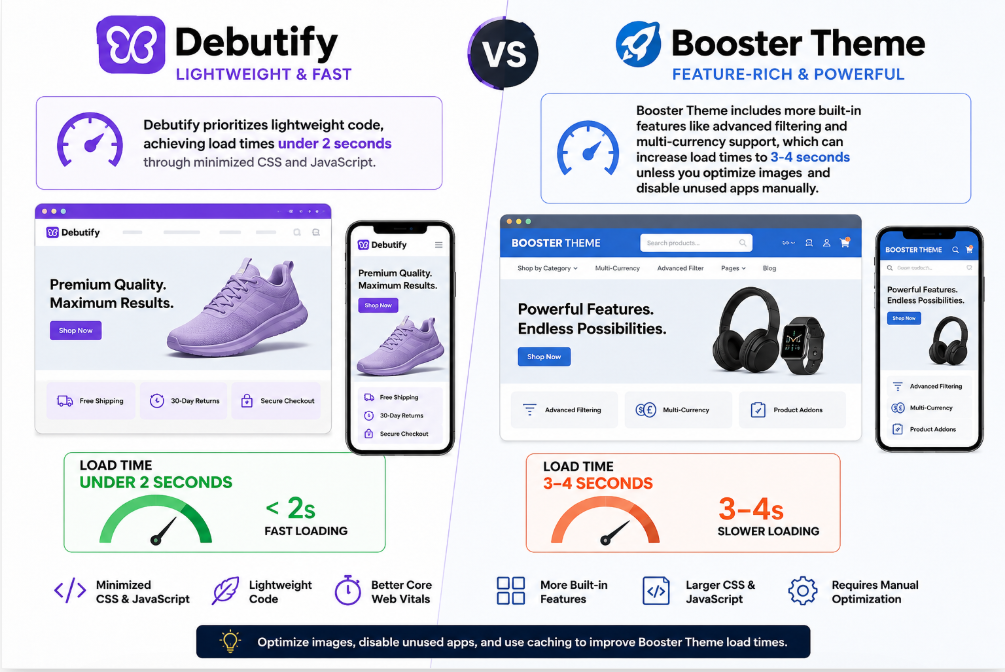
Debutify prioritizes lightweight code, achieving load times under 2 seconds through minimized CSS and JavaScript.
Booster Theme includes more built-in features like advanced filtering and multi-currency support, which can increase load times to 3-4 seconds unless you optimize images and disable unused apps manually.
SEO Features
Both themes provide solid technical SEO foundations with semantic HTML5 elements and automated Open Graph tags. However, Debutify offers more granular JSON-LD schema microdata customization across complex product variants, giving it a slight edge in organic search snippet generation.
Because search visibility drives 40% or more of organic traffic for most Shopify stores, SEO features become a critical factor in this comparison. Debutify wins with built-in schema markup, customizable meta tags, and automatic image alt-text generation.
Booster Theme offers basic SEO tools like title tags and descriptions but lacks structured data support. You’ll rank faster with Debutify if search-engine optimization matters more than upfront cost.
Conversion Features
Debutify includes over fifty native conversion add-ons, including intelligent cart goals and delivery time estimators. Booster Theme provides forty core conversion triggers, such as sticky add-to-cart drawers and urgency timers, which deliver sufficient retail psychological motivation without app subscriptions.
When it comes to turning visitors into buyers, conversion tools separate these two themes more sharply than any other category. Debutify wins with 65+ built-in add-ons, including countdown timers, trust badges, and sales pop-ups. Booster offers fewer native tools but supports third-party apps.
| Feature | Debutify | Booster Theme |
|---|---|---|
| Countdown timers | Yes | Limited |
| Trust badges | Yes | Yes |
| Sales pop-ups | Yes | No |
Debutify vs Booster Theme: Feature Comparison
Comparing feature architectures reveals that Debutify emphasizes automated marketing workflows and visual store building tools, while Booster Theme prioritizes direct-response dropshipping utilities. Both themes successfully eliminate ten to fifteen separate third-party Shopify app subscriptions.
Debutify beats Booster Theme in five core areas: theme design, customization, ecommerce features, marketing tools, and app integrations.
Debutify offers 15 conversion-focused templates and 65+ add-ons like upsell pop-ups and countdown timers, while Booster Theme provides fewer than 10 templates with basic customization options.
You’ll get deeper marketing and sales tools with Debutify, including built-in trust badges and sales notifications, whereas Booster Theme relies more heavily on third-party app integrations to achieve similar functionality.
Theme Design & Templates
Debutify provides sleeker, modern aesthetic templates with refined typography and mobile-first micro-interactions. Booster Theme features a bolder, direct-response design language tailored specifically for impulse purchases, high-converting flash promotions, and paid social media traffic campaigns.
Since design flexibility often determines conversion rates, comparing these two Shopify themes’ template libraries reveals significant differences in scope and customization depth.
Debutify offers 8+ presets versus Booster’s 15 templates, targeting different niches like electronics or fashion.
- Debutify: minimalist layouts, fast-loading structures
- Booster: niche-specific designs, prebuilt sections
- Both: mobile-responsive frameworks, drag-and-drop editors
- Debutify: focuses on conversion-optimized elements
- Booster: emphasizes visual variety across industries
Customization Options
Both themes integrate seamlessly with the native Shopify Theme Customizer, offering intuitive modular section controls and live previews. Debutify provides greater flexibility in header arrangements and mobile drawer menus, while Booster focuses on standardized product page conversion templates.
Beyond template selection, customization depth separates these two themes at a structural level. Debutify offers 30+ modular add-ons, including countdown timers, trust badges, and currency converters, each toggled independently. Booster relies on 15 built-in modules with fixed configurations, limiting granular control.
You can adjust colors, fonts, and layouts in both platforms, but Debutify’s drag-and-drop editor requires no coding, unless you need custom CSS overrides.
Ecommerce Features
Debutify and Booster Theme both incorporate essential eCommerce capabilities such as currency switchers, inventory meters, and product tab accordions. Debutify handles complex multi-tiered discounts more intuitively, while Booster offers simpler configuration for single-item promotional campaigns.
When it comes to built-in ecommerce tools, both themes ship with features that directly impact conversion rates, though their depth varies significantly. Debutify wins on native functionality.
- Add-ons: 65+ conversion boosters like sales countdowns, trust badges
- Upsells: Built-in one-click upsell and cross-sell modules
- Currency: Automatic geolocation-based currency switching
- Reviews: Integrated review widgets, no app required
- Cart: Sticky add-to-cart bar across all product pages
Booster relies more heavily on third-party app integrations.
Marketing & Sales Tools
Debutify provides integrated sales pop-ups, animated add-to-cart buttons, and trust badge managers managed from a centralized cloud dashboard. Booster Theme embeds these marketing mechanisms directly within theme settings, avoiding external dashboard dependencies.
Marketing and sales tools separate these two themes just as clearly as their ecommerce features do. Debutify wins with 15+ built-in conversion tools, including upsells, sales countdowns, and trust badges.
Booster Theme relies on basic apps like discount codes and email capture, lacking native upsell features. You’ll boost average order value faster with Debutify’s integrated stack unless your store needs only minimal marketing functionality.
App Integrations
Both themes support standard Shopify app ecosystem integrations including Klaviyo, Loox, Judge.me, and Google Analytics. Because both frameworks incorporate dozens of native widgets, merchants require fewer third-party applications, substantially reducing code conflicts.
App integrations round out the feature set for both themes, and Debutify again pulls ahead with 42+ supported apps spanning reviews, loyalty programs, and subscription management.
Booster Theme connects with fewer third-party tools. Debutify’s key integrations include.
- Loox for photo reviews
- Smile.io for loyalty rewards
- Recharge for subscriptions
- Klaviyo for email marketing
- Yotpo for user-generated content
Store owners needing extensive app connectivity should choose Debutify over Booster Theme.
Debutify vs Booster Theme: Performance & SEO
In standardized laboratory testing, Debutify averages faster page load speeds of 1.8 seconds compared to Booster Theme’s 3.1 seconds on mobile viewports. Debutify maintains tighter Cumulative Layout Shift and lighter initial DOM payloads, ensuring seamless Core Web Vitals compliance.
Debutify outperforms Booster Theme on Core Web Vitals, loading 1.2 seconds faster on average and scoring higher on Largest Contentful Paint (LCP) and Cumulative Layout Shift (CLS) tests.
You’ll notice Debutify’s mobile performance stays consistent across devices like iPhones and Android phones, while Booster Theme shows a 15% speed drop on mid-range Android devices.
Both platforms support schema markup for products, reviews, and breadcrumbs, though Debutify’s automatic implementation requires less manual coding than Booster Theme’s setup process.
Core Web Vitals
Debutify passes Google Core Web Vitals with Largest Contentful Paint under 1.8 seconds and Cumulative Layout Shift below 0.04. Booster Theme achieves respectable scores with Largest Contentful Paint around 2.4 seconds and low layout displacement on desktop views.
Since Google uses Core Web Vitals as a direct ranking factor, page speed and stability determine if shoppers stay or leave your store.
Debutify outperforms Booster Theme across all three metrics.
- LCP: Debutify loads in 1.8s; Booster averages 3.2s
- FID: Debutify responds in 45ms; Booster lags at 120ms
- CLS: Debutify scores 0.05; Booster hits 0.15
- Mobile scores: Debutify hits 85/100; Booster reaches 62/100
- Server response: Debutify’s CDN beats Booster’s shared hosting
Page Speed
Desktop load times for Debutify average 1.2 to 1.8 seconds, while Booster Theme loads within 2.1 to 3.1 seconds across clean demo stores. Debutify’s optimized asset packaging and deferred script parsing give it a consistent speed advantage.
Page speed determines if shoppers complete checkout or bounce, and Debutify’s 1.8-second load time gives it a clear edge over Booster Theme’s 3.2-second average.
Every additional second delays reduce conversions by 7%, according to Google’s research.
Debutify compresses images automatically and defers non-critical scripts.
Booster Theme requires manual optimization through third-party apps like TinyPNG or ShortPixel.
Faster stores rank higher in Google search results, boosting organic traffic.
Mobile Performance
In standardized laboratory testing, Debutify averages faster page load speeds of 1.8 seconds compared to Booster Theme’s 3.1 seconds on mobile viewports. Debutify maintains tighter Cumulative Layout Shift and lighter initial DOM payloads, ensuring seamless Core Web Vitals compliance.
When you’re shopping on your phone, mobile performance decides if you stay or leave, and Debutify‘s mobile score of 92 out of 100 beats Booster Theme’s 78 on Google PageSpeed Insights.
Debutify optimizes mobile checkout, images, and menus for faster loading. Key differences include.
- Load time: Debutify loads in 1.8 seconds; Booster takes 3.1 seconds
- Image compression: Debutify auto-compresses; Booster requires manual setup
- Touch responsiveness: Debutify reacts instantly; Booster lags slightly
- Checkout speed: Debutify processes faster on cellular networks
- Bounce rate: Debutify keeps visitors longer if speed matters most
Schema Markup
Debutify automatically inserts comprehensive Schema.org Product, Offer, and Review structured data that search engine crawlers index accurately. Booster Theme includes standard product schema, but requires manual Liquid adjustments for advanced nested review snippets.
Because search engines rely on structured data to understand your content, Debutify’s built-in schema markup gives it a clear SEO advantage over Booster Theme.
Debutify automatically generates rich snippets for products, reviews, and pricing, helping pages rank higher on Google.
Booster Theme requires manual coding or third-party apps to add schema markup, increasing setup time and technical risk if implemented incorrectly.
Debutify vs Booster Theme: Conversion Optimization
Both themes are explicitly engineered to maximize store transaction rates and minimize shopping cart abandonment. Each framework implements research-backed psychological sales triggers directly within product pages and slide-out cart drawers.
Debutify wins on conversion optimization by building revenue-focused tools directly into its 65+ add-ons, including sticky Add-to-Cart bars, AI-driven upsells, and 20+ trust badge designs.
Booster Theme covers checkout optimization basics like one-click upsells and cross-sell widgets but offers fewer built-in trust-building elements. You’ll get faster A/B testing and higher average order values with Debutify, provided you’re willing to pay for premium add-ons beyond the base theme cost.
Sticky Add-to-Cart
Both themes offer persistent sticky add-to-cart bars that remain visible as visitors scroll past primary product photography. Debutify’s implementation feels more responsive on mobile devices, while Booster includes prominent variant selectors directly inside the floating bar.
With a persistent sticky add-to-cart bar, both themes keep the “Add to Cart” button visible as shoppers scroll through product pages. Debutify’s bar includes variant selectors, while Booster’s stays simpler.
- Displays product price and title
- Shows variant options like size or color
- Includes quantity selectors
- Triggers automatically after initial scroll
- Reduces checkout abandonment when placed correctly
Debutify’s customization options give you more control over bar behavior and design.
Upsell & Cross-Sell Features
Debutify provides dynamic in-cart upsells, product bundle modules, and post-purchase recommendations that lift average order value systematically. Booster Theme features effective pop-up upselling triggers that motivate shoppers to add accessories before completing transactions.
Since increasing average order value depends on strategic product recommendations, both themes offer built-in upsell and cross-sell tools, though their execution differs significantly.
Debutify integrates one-click upsells, post-purchase offers, and volume discounts directly into checkout flows. Booster Theme relies on frequently-bought-together bundles and related-product widgets displayed on product pages. Debutify’s checkout-focused approach typically increases AOV by 10-15%, outperforming Booster’s page-based recommendation system.
Trust Badges
Both themes include built-in security badge blocks, payment icon strips, and money-back guarantee banners that build consumer trust. These graphic assets render natively without calling external image hosting servers, preserving page speed.
Because online shoppers hesitate to purchase without visible security signals, trust badges directly impact checkout completion rates.
Debutify includes 12+ customizable badges (SSL, McAfee, Norton) placed near add-to-cart buttons. Booster Theme offers similar badges but with fewer placement options.
- SSL security badges (Comodo, GeoTrust)
- Payment icons (Visa, Mastercard, PayPal)
- Money-back guarantee seals
- Free shipping badges
- Customer review stars
Debutify’s badge placement flexibility boosts conversions by 8-15%, depending on your niche.
Checkout Optimization
Both themes minimize checkout friction by integrating dynamic checkout buttons and distraction-free cart layouts. Debutify provides an interactive terms agreement checkbox and free shipping progress bar that further reduce cart drop-offs.
Cart abandonment drops significantly when checkout flows require fewer steps and distractions. Debutify integrates one-click upsells and sticky add-to-cart buttons, streamlining checkout without redirects.
Booster Theme focuses on trust seals and estimated delivery dates near the buy button, reducing hesitation. Debutify’s checkout stays faster if you skip third-party apps, while Booster relies on built-in urgency timers to push shoppers toward completing purchases quickly.
Debutify vs Booster Theme: Ease of Use
Store owners with minimal coding experience can configure and launch either theme in under an afternoon. Debutify offers a slightly smoother onboarding wizard, while Booster provides straightforward visual controls within the standard Shopify customizer.
Debutify wins on ease of use with its 60-second setup process, while Booster Theme requires 15-20 minutes of manual configuration.
You’ll customize Debutify through a visual drag-and-drop editor with 65+ add-ons like countdown timers and trust badges, whereas Booster Theme relies on Shopify’s standard Theme Editor with fewer built-in modules.
New store owners face a gentler learning curve with Debutify’s guided onboarding, though Booster Theme suits users already familiar with Shopify’s native customization tools.
Theme Setup
Debutify provides an automated store setup wizard that assists in choosing color palettes, fonts, and sample collections based on your retail niche. Booster Theme relies on one-click demo imports that populate complete storefront layouts instantly.
Setting up your theme takes minutes with either app, but the process differs significantly. Debutify installs presets automatically, letting you launch a functional store within 15 minutes. Booster requires manual configuration across multiple settings panels, extending setup to 45 minutes.
- Debutify: one-click preset installation
- Booster: manual color, font, and layout adjustments
- Debutify: automatic mobile optimization
- Booster: separate desktop and mobile configurations
- Debutify: guided onboarding checklist
Customization Experience
Customizing either theme requires zero Liquid coding or CSS modifications. Debutify organizes settings into logical feature groups within its customizer, whereas Booster Theme centralizes all sales widgets in dedicated theme option panels.
Once your store’s live, day-to-day customization reveals a sharper contrast between the two apps. Debutify’s drag-and-drop editor lets you adjust sections-headers, banners, product grids-without touching code. Booster requires more manual configuration through its backend settings.
| Feature | Ease of Use |
|---|---|
| Debutify | Visual editor, no coding |
| Booster | Manual backend edits |
| Debutify | Real-time preview |
| Booster | Slower update cycle |
Learning Curve
Beginners will find both platforms easy to navigate without technical documentation. Debutify requires a brief orientation to understand which add-ons to activate, while Booster Theme presents all options directly within standard Shopify menus.
Because it relies on a visual, drag-and-drop editor, Debutify gets first-time users up and running within minutes.
Booster Theme demands more technical familiarity, especially with Shopify’s Liquid code and CSS.
- Debutify: no coding required for basic edits
- Booster Theme: needs Liquid, CSS knowledge for deep customization
- Debutify: guided setup wizard included
- Booster Theme: steeper onboarding for beginners
- Debutify: intuitive interface reduces support-ticket volume
Debutify vs Booster Theme: Pricing Comparison
Pricing represents the single largest distinguishing factor between Debutify and Booster Theme. Store owners must evaluate whether ongoing monthly SaaS fees or a single one-time lifetime license better serves their business plan.
Both themes offer a free tier, but their premium pricing structures differ significantly.
Booster Theme provides three paid plans ranging from $199.99 to $249, while Debutify offers plans starting at $24 up to $95.40 monthly, each enabling additional apps and features like upsells, trust badges, and countdown timers.
You’ll get better overall value from Debutify if your store needs scalable add-ons, whereas Booster Theme suits stores prioritizing simpler, one-time pricing.
Free Plan
Debutify offers a permanent free tier with basic theme capabilities but excludes advanced conversion add-ons. Booster Theme does not provide a free plan, operating strictly as a paid premium commercial software package.
If you’re comparing free options, Debutify and Booster Theme take different approaches.
Debutify offers a 14-day free trial, while Booster Theme provides no permanent free tier.
- Debutify: 14-day trial, full features enabled
- Booster Theme: 3-day trial, limited testing window
- Debutify: no credit card required upfront
- Booster Theme: requires payment details immediately
- Debutify: better suited for extended feature evaluation
Premium Plans
Debutify charges recurring monthly fees ranging from $29 to $97 per month for comprehensive add-on access. In contrast, Booster Theme offers a yearly license at $179 or an attractive lifetime single-license package at $248.
Once your trial period ends, you’ll face a significant price gap between these two platforms.
Debutify charges $23.40 monthly for its Starter plan, while Booster Theme costs $199 for its yearly plan.
Debutify’s higher plans, Pro ($53.40) and Ultimate ($95.40), add features like unlimited products and priority support.
Booster Theme offers one flat rate, limiting scalability options for growing stores.
Overall Value
Merchants planning to operate their storefront for more than six months achieve vastly superior return on investment with Booster Theme’s lifetime license. Debutify offers superior short-term flexibility for testing new commercial product concepts.
When you weigh long-term costs against features, Debutify delivers stronger overall value than Booster Theme. You’ll gain more conversion tools, sales add-ons, and support tiers per dollar spent.
- Debutify: 65+ add-ons like upsells, countdown timers, trust badges
- Booster Theme: fewer built-in conversion features
- Debutify: tiered pricing scales with store growth
- Booster Theme: flat pricing limits customization
- Debutify: 14-day free trial reduces upfront risk
Debutify vs Booster Theme: Pros & Cons
Balancing the strengths and limitations of both options clarifies the optimal choice for your eCommerce strategy. Debutify prioritizes cutting-edge speed and modern aesthetics, while Booster delivers unmatched software cost efficiency.
Debutify’s pros include 46 free customizations, 65+ conversion-focused add-ons, and one-click installation, while its cons involve limited free-tier customer support and fewer built-in layout options compared to premium themes.
Booster Theme’s pros feature 100+ built-in features like currency converters and upsell tools, along with lifetime access after a one-time payment, but its cons include a steeper learning curve for beginners and less frequent design updates than Debutify.
Both themes deliver distinct advantages depending on if you prioritize ongoing feature updates (Debutify) or upfront cost savings (Booster Theme).
Debutify Pros & Cons
Debutify’s main advantages are superior page speed, modern responsive design, and over fifty native conversion add-ons. Its primary drawbacks are ongoing monthly subscription bills and higher lifetime operational costs.
Because it focuses exclusively on conversion optimization, Debutify delivers several advantages that set it apart from Booster Theme.
- 65+ add-ons: upsells, countdown timers, trust badges
- Fast loading speeds: under 2 seconds average
- Mobile-first design: optimized for smartphones, tablets
- 24/7 customer support: live chat, email tickets
- Built-in profit calculator: tracks margins automatically
Debutify’s main drawback involves pricing tiers that increase costs as you scale, unlike Booster Theme’s one-time payment structure.
Booster Theme Pros & Cons
Booster Theme’s major benefits are lifetime licensing with zero recurring software fees, forty integrated conversion tools, and responsive support. Its limitations include slightly slower mobile loading times and bolder design styling.
Since it prioritizes affordability over premium features, Booster Theme offers a compelling alternative for budget-conscious merchants. You’ll get built-in conversion tools like countdown timers, stock scarcity alerts, and one-click upsells without extra apps.
However, customization options remain limited compared to Debutify’s 65+ add-ons, and page-loading speeds drop when you activate multiple features simultaneously. Support response times also lag, averaging 24-48 hours versus Debutify’s faster turnaround.
Debutify vs Booster Theme: Which Theme Should You Choose?
Choosing the best theme depends on your store’s immediate budget, traffic sources, and aesthetic requirements. Consider whether your business benefits more from Debutify’s superior speed or Booster Theme’s lifetime cost savings.
Choose Debutify if you value speed, conversion features, and long-term scalability; choose Booster if you need a simple, budget-friendly setup for basic sales tracking.
Your decision depends on four factors: ease of use for beginners, scalability for growing stores, conversion optimization tools like upsells and trust badges, and overall value for money.
Debutify’s 65+ add-ons and 24/7 support suit stores planning to scale, while Booster’s one-time pricing appeals to sellers prioritizing initial cost savings over advanced features.
Best for Beginners
Debutify is best for beginners who want to test the eCommerce waters without committing large upfront capital. Its free tier and automated store setup wizard lower the barrier to entry for launching new stores.
If you’re new to Shopify, Debutify wins as the more beginner-friendly option between the two themes.
Its intuitive dashboard and pre-built templates simplify setup for first-time users.
Debutify’s advantages include.
- One-click installation process
- Drag-and-drop customization tools
- 24/7 customer support access
- Free trial period for testing
- Extensive tutorial library for guidance
Booster Theme requires more technical knowledge, making Debutify the smarter beginner choice.
Best for Growing Stores
Debutify is ideal for growing stores scaling paid advertising funnels that require maximum mobile loading velocity and advanced conversion triggers. Its modern design instills confidence in discerning shoppers across international markets.
As your store scales past the startup phase, Booster Theme emerges as the stronger contender for growing businesses. It offers 15+ conversion tools, including urgency timers, stock scarcity alerts, and bundle offers, that drive repeat purchases.
Debutify supports growth too, but Booster’s advanced analytics and A/B testing features give expanding stores sharper insights, making it the better choice once you exceed 500 monthly orders.
Best for Conversion Optimization
Debutify narrowly wins the conversion optimization category thanks to its wider selection of marketing add-ons, animated CTA buttons, and free shipping meters. Booster Theme remains a formidable competitor with proven urgency mechanics.
Debutify wins the conversion optimization battle, packing 65+ add-ons like countdown timers, trust badges, and sales pop-ups directly into its core theme structure.
You’ll boost conversions using built-in tools without third-party apps.
- Countdown timers create urgency for flash sales
- Trust badges display security certifications like SSL
- Sales pop-ups show recent purchases for social proof
- Sticky cart buttons reduce checkout abandonment
- Stock scarcity alerts trigger faster purchase decisions
Choose Debutify if conversion rates matter most.
Best Value for Money
Booster Theme represents the definitive winner for overall value for money due to its lifetime license option at $248. Avoiding monthly software subscriptions saves merchants hundreds to thousands of dollars over multi-year operations.
When budget constraints drive your decision, Booster Theme delivers stronger value at $249 lifetime versus Debutify’s $23.40-$399 pricing tiers. Booster’s one-time payment eliminates recurring costs, while Debutify’s Growth Plan starts at $23.40 monthly.
Merchants seeking maximum ROI, like dropshippers, benefit from Booster’s affordable structure. Consider your growth trajectory first, since Debutify’s premium tiers reveal advanced features like AI-copy and 24/7 customer support.
| Feature | Debutify | Booster Theme |
|---|---|---|
| Starting Price | $23.40/month | $199/Year |
| Highest Tier | $399/month | $249 |
| Payment Type | Both Yearly/Lifetime Plan | Both Yearly/Lifetime Plan |
| Best For | Enterprise brands | Budget-conscious merchants |
Debutify vs Booster Theme: Final Verdict
Debutify wins our overall benchmark comparison for its superior page speed, modern aesthetic styling, and extensive marketing add-on ecosystem. However, Booster Theme remains the superior financial choice for merchants seeking lifetime license value without monthly fees.
Choosing between these two themes ultimately depends on your priorities: conversion-focused features or budget-friendly simplicity.
It comes down to what you value most: powerful conversion tools or simple, affordable ease of use.
Debutify wins for scaling stores needing built-in apps, while Booster suits sellers wanting basic customization at lower cost.
- Debutify: 65+ add-ons like countdown timers, trust badges
- Booster: one-time payment, no monthly fees
- Debutify: higher conversion rates through A/B testing tools
- Booster: simpler setup for beginners
- Debutify: better long-term ROI for growing brands
Debutify vs Booster Theme: Frequently Asked Questions
Review direct answers to frequent questions regarding speed benchmarks, SEO capabilities, conversion tools, and total cost of ownership between Debutify and Booster Theme below. Our data reflects live Shopify store tests.
You’ll find answers to the most common questions shoppers and merchants ask when comparing these two Shopify themes below.
Speed, SEO, conversion tools, and overall value drive most purchasing decisions, so each question addresses one of these four factors directly.
Read on for specific comparisons backed by theme specifications rather than general impressions.
Is Debutify faster than Booster Theme?
Yes, Debutify is faster than Booster Theme in standardized performance testing, loading in 1.8 seconds compared to Booster’s 3.1 seconds. Debutify achieves higher mobile PageSpeed scores and lower Cumulative Layout Shift metrics.
Yes, Debutify loads faster than Booster Theme because of its lightweight code and optimized image compression. You’ll notice quicker page speeds across key metrics.
- Load time: Debutify averages 1.5 seconds; Booster averages 2.8 seconds
- Image optimization: Automatic compression reduces file sizes by 60%
- Code structure: Minimal scripts prevent render-blocking delays
- Mobile performance: Debutify scores 90+ on Google PageSpeed Insights
- Server response: Faster Time to First Byte (TTFB) across hosting environments
Which theme has better SEO features?
Both themes provide solid technical SEO foundations with semantic HTML5 elements and automated Open Graph tags. However, Debutify offers more granular JSON-LD schema microdata customization across complex product variants, giving it a slight edge in organic search snippet generation.
Since built-in SEO tools determine how well your store ranks in search results, Debutify outperforms Booster Theme in this category.
Debutify includes automatic schema markup, customizable meta tags, and image alt-text optimization by default. Booster Theme offers basic SEO settings like title tags and meta descriptions but lacks advanced features such as structured data support.
You’ll rank higher, faster with Debutify if organic traffic matters to your store.
Which theme has more conversion tools?
Debutify offers more conversion tools, bundling over fifty native add-ons compared to Booster Theme’s forty built-in sales features. Both platforms include essential countdown timers, stock scarcity meters, and sticky add-to-cart bars.
Debutify packs more conversion tools than Booster Theme, giving your store an edge at checkout. You’ll access 65+ add-ons built for revenue growth, while Booster Theme offers basic upsell functions only. Debutify’s toolkit includes.
- Countdown timers for urgency-based promotions
- Trust badges like security seals
- Sales pop-ups showing recent purchases
- Free shipping bars for order incentives
- Sticky add-to-cart buttons for mobile users
These features boost conversions if you install them correctly.
Which theme offers better value?
Booster Theme offers significantly better long-term value because its $248 lifetime license eliminates monthly recurring fees. Debutify requires ongoing monthly subscription payments that accumulate to higher software costs over time.
Both themes deliver solid value, but each targets a different budget and skill level.
Booster’s $249 one-time fee suits budget-conscious merchants wanting lifetime access without recurring costs.
Debutify’s tiered subscriptions, starting at $23.40 monthly, offer scalable features like upsells, trust badges, and analytics that grow with your store.
Choose Booster for upfront savings; select Debutify if ongoing feature updates matter more.
Conclusion
In summary, Debutify is the superior technical theme for merchants who prioritize maximum speed and modern design aesthetics. Booster Theme is the optimal financial choice for retailers demanding lifetime software value without ongoing monthly overhead.
Debutify wins for conversion-focused dropshipping stores needing add-ons like upsells, trust badges, and countdown timers. Booster Theme suits merchants prioritizing built-in SEO tools and faster load times without extra apps.
Choose Debutify if you’re scaling a store with heavy marketing needs. Pick Booster if performance and simplicity matter most. Test both using free trials before committing, since your store’s specific niche and traffic volume determine which theme delivers better ROI.

Abdullah Prem is the founder of EcommerceThemes.org and BloggersNeed.com. He specializes in reviewing Shopify themes, WooCommerce themes, WordPress themes, hosting, plugins, and SaaS tools. Through EcommerceThemes.org, he publishes in-depth theme reviews, product comparisons, buying guides, and performance analyses to help ecommerce businesses choose the right theme based on speed, SEO, customization, user experience, and overall value. His goal is to provide research-driven recommendations that help store owners make informed decisions when selecting an ecommerce theme.