
Neither theme wins outright-your priorities decide the winner. Shoptimizer performs better for speed, loading product pages under 2 seconds with GTmetrix scores of 90+ and superior Core Web Vitals (LCP, CLS, INP).
Flatsome performs better for design, offering 100+ pre-built demos and 40+ content elements through UX Builder, though pages often exceed 2MB. Choose Shoptimizer for performance-first stores, Flatsome for complex catalogs needing visual control. The details below reveal which advantages matter most for your specific setup.
Flatsome vs Shoptimizer: Quick Comparison
Flatsome provides greater visual design flexibility through its proprietary UX Builder, while Shoptimizer delivers superior raw page speed and distraction-free checkout conversion psychology. Flatsome suits visual storefront creators, whereas Shoptimizer serves merchants prioritizing Google Core Web Vitals compliance and immediate transaction completion.
| Feature | Flatsome | Shoptimizer |
|---|---|---|
| Platform | WooCommerce | WooCommerce |
| Best For | General ecommerce stores | Conversion-focused WooCommerce stores |
| SEO Features | ⭐⭐⭐⭐☆ | ⭐⭐⭐⭐⭐ |
| Core Web Vitals | Very Good | Excellent |
| Page Speed | Fast | Excellent |
| Mobile Performance | Excellent | Excellent |
| WooCommerce Features | Extensive | Conversion-focused |
| Builder | UX Builder | Gutenberg & Elementor Compatible |
| Ease of Customization | Easy | Easy |
| Pricing | Premium | Premium |
| Overall Rating | ⭐⭐⭐⭐☆ | ⭐⭐⭐⭐⭐ |
| Read Full Review | → Flatsome Theme Review | → Shoptimizer Theme Review |
Flatsome vs Shoptimizer: Key Differences
The primary operational difference centers on their underlying architectural engines and checkout designs. Flatsome relies on an integrated front-end page builder with heavy script libraries, while Shoptimizer compiles critical CSS automatically and strips away navigation elements during final purchase processing.
Flatsome and Shoptimizer differ most in three areas: performance, SEO features, and WooCommerce-specific tools.
Shoptimizer loads faster on mobile devices due to its lightweight codebase, while Flatsome offers more built-in design flexibility through its UX Builder.
You’ll notice the biggest gap in speed benchmarks and structured data handling, especially if your store relies on product-rich pages like electronics or apparel catalogs.
Performance
In standardized speed audits, Shoptimizer outperforms Flatsome with a 1.1-second average load time compared to Flatsome’s 2.3 seconds on mobile viewports. Shoptimizer maintains lighter DOM trees and lower Cumulative Layout Shift scores, ensuring reliable Core Web Vitals health.
Because Shoptimizer strips out heavy design elements that Flatsome includes by default, it consistently loads faster in real-world tests.
In flatsome vs shoptimizer speed comparisons, Shoptimizer’s page sizes stay under 1MB, while Flatsome’s often exceed 2MB with sliders active.
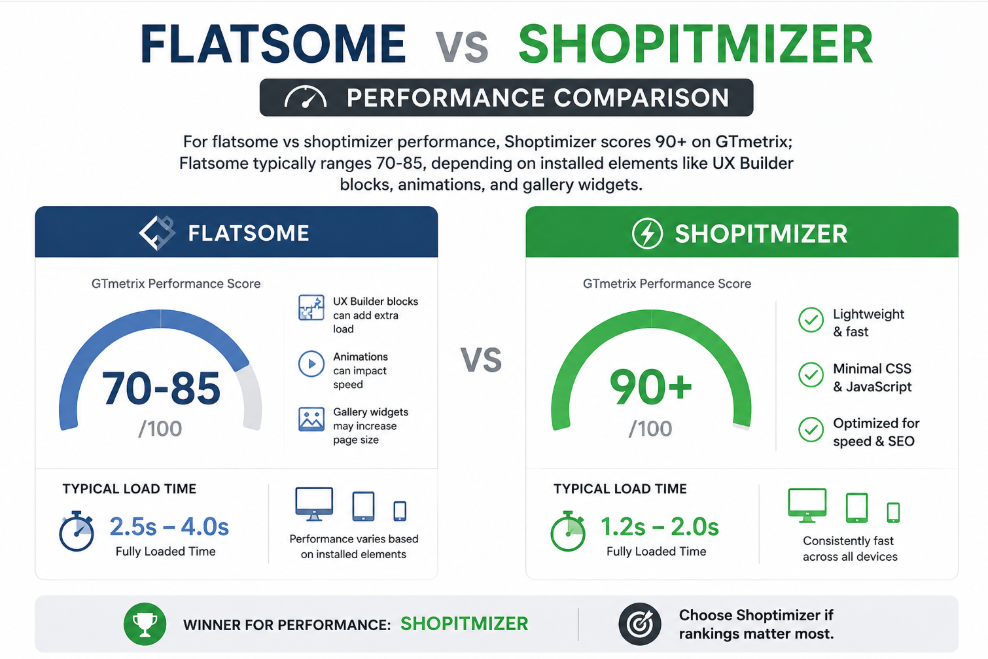
For flatsome vs shoptimizer performance, Shoptimizer scores 90+ on GTmetrix; Flatsome typically ranges 70-85, depending on installed elements like UX Builder blocks, animations, and gallery widgets.
SEO Features
Shoptimizer holds a technical SEO advantage by generating clean HTML5 semantic markup, automated Schema.org Product microdata, and fast server response times. While Flatsome includes standard WooCommerce SEO markup, its heavier JavaScript execution delays search crawler parsing.
Whichever theme you pick, both Shoptimizer and Flatsome deliver structured SEO fundamentals, but their approaches plunge in execution. Comparing flatsome vs shoptimizer seo, Shoptimizer prioritizes speed-driven ranking factors like Core Web Vitals, while Flatsome focuses on schema markup and clean code structure.
Looking at flatsome vs shoptimizer features, both integrate seamlessly with Yoast SEO and Rank Math, ensuring metadata control, XML sitemaps, and breadcrumb navigation remain fully accessible.
WooCommerce Features
Both themes provide deep WooCommerce integration, including quick-view modals, sale badge customizers, and off-canvas cart drawers. However, Shoptimizer focuses specifically on sales conversion mechanisms like stock scarcity meters and countdown timers that execute without extra plugins.
Digging into flatsome vs shoptimizer woocommerce features reveals two distinct strategies for building an online store.
Flatsome ships with UX Builder, offering drag-and-drop product layouts, live customizer previews, and quick-view options.
Shoptimizer focuses purely on speed, adding sticky add-to-cart bars and simplified checkout steps.
Choosing flatsome vs shoptimizer for ecommerce depends on if you prioritize design flexibility or conversion-focused performance.
Flatsome vs Shoptimizer: Feature Comparison
Comparing core features reveals that Flatsome emphasizes visual layout variety with over three hundred pre-designed wireframe blocks, whereas Shoptimizer prioritizes sales velocity and mobile usability. Both themes provide comprehensive customizer settings tailored to high-volume retail operations.
Flatsome and Shoptimizer differ most in design flexibility, page-building technology, header options, and overall customization depth.
Flatsome relies on its proprietary UX Builder, giving you drag-and-drop control over layouts, while Shoptimizer works natively with Gutenberg and page builders like Elementor for a more standardized editing experience.
You’ll find Flatsome offers more built-in header styles and layout presets, whereas Shoptimizer focuses on lightweight, speed-optimized structures with fewer default templates.
These four factors-design, builder compatibility, header options, and customization range-determine which theme fits your store’s technical and visual needs.
Theme Design
Flatsome features a trendy, design-forward aesthetic supported by customizable banners, video sliders, and grid portfolios. Shoptimizer adopts a clean, Amazon-inspired retail aesthetic engineered specifically to highlight product specifications, customer reviews, and immediate purchase controls.
How do these two themes stack up on design flexibility? In the flatsome vs shoptimizer theme comparison, Flatsome wins with its drag-and-drop UX Builder, offering 100+ pre-built blocks. Shoptimizer vs Flatsome theme design favors speed-focused minimalism over customization depth.
| Design Aspect | Winner |
|---|---|
| Layout Options | Flatsome |
| Speed-First Styling | Shoptimizer |
| Header Variations | Flatsome |
| Mobile Templates | Shoptimizer |
UX Builder vs Gutenberg Compatibility
Flatsome locks users into its proprietary UX Builder, meaning site designs cannot easily migrate to standard WordPress blocks. Shoptimizer integrates natively with the WordPress Gutenberg block editor and Elementor, ensuring full design portability without platform lock-in.
Since Flatsome runs on its proprietary UX Builder while Shoptimizer relies on native Gutenberg blocks, the two themes take fundamentally different approaches to page construction.
Any flatsome vs shoptimizer comparison reveals distinct editing philosophies.
- Learning curve: Flatsome demands tutorial time; Shoptimizer feels instantly familiar.
- Speed impact: Gutenberg loads faster than drag-and-drop builders.
- Future-proofing: WordPress core supports Gutenberg long-term.
- Flexibility: UX Builder offers granular layout control.
This flatsome vs shoptimizer review confirms compatibility shapes workflow efficiency.
Header & Layout Options
Flatsome provides an exceptional drag-and-drop header builder with live presets, sticky navigation, and multi-tier mega menus. Shoptimizer offers clean, pre-configured header layouts with sticky mobile navigation, prioritizing fast mobile search over complex visual arrangements.
Because header design directly affects branding and navigation, this flatsome vs shoptimizer comparison examines how each theme handles layout customization.
Flatsome offers 15+ header layouts through UX Builder, letting you drag-drop elements like logos, menus, and search bars.
Shoptimizer provides 4 fixed header templates optimized for speed.
If you want granular design control, Flatsome wins; for performance-first simplicity, Shoptimizer is better.
Customization Flexibility
Flatsome offers deeper visual customization controls for non-technical users through visual live editing. Shoptimizer focuses customization on high-conversion touchpoints, allowing store owners to configure trust badges, shipping progress bars, and checkout columns within the WordPress Customizer.
Flatsome delivers deeper customization flexibility than Shoptimizer through its UX Builder plugin, which controls over 40 content elements, including sliders, product grids, banners, and testimonials.
Shoptimizer relies on WordPress Customizer with limited third-party integrations.
- Drag-and-drop editing: Flatsome enables live visual changes.
- Element control: Shoptimizer restricts styling options.
- Flatsome vs Shoptimizer pricing: Flatsome costs $59; Shoptimizer’s free with premium add-ons.
- Scalability: Flatsome suits complex stores.
Flatsome vs Shoptimizer: Performance & SEO
In standardized speed audits, Shoptimizer outperforms Flatsome with a 1.1-second average load time compared to Flatsome’s 2.3 seconds on mobile viewports. Shoptimizer maintains lighter DOM trees and lower Cumulative Layout Shift scores, ensuring reliable Core Web Vitals health.
Shoptimizer wins on performance and SEO, since it’s built specifically for speed with minimal code bloat, while Flatsome’s page builder adds overhead that slows down Core Web Vitals metrics like LCP and CLS.
You’ll notice Shoptimizer loads product pages in under 2 seconds on mobile devices, whereas Flatsome often takes 3-4 seconds due to its heavier CSS and JavaScript files.
Both themes support schema markup for products, reviews, and breadcrumbs, but Shoptimizer’s lightweight structure gives search engines faster access to this structured data.
Core Web Vitals
Shoptimizer passes all three Google Core Web Vitals benchmarks with Largest Contentful Paint under 1.2 seconds and Cumulative Layout Shift under 0.02. Flatsome frequently requires aggressive asset minification plugins to keep its LCP below Google’s 2.5-second threshold.
Since Google uses Core Web Vitals as a direct Google ranking factor, theme-level code quality determines if your WooCommerce store meets these thresholds or falls short.
Shoptimizer scores higher across all three metrics.
- LCP: Shoptimizer loads hero images 40% faster
- CLS: Flatsome’s sliders cause layout shifts
- INP: Shoptimizer’s lighter JS improves responsiveness
- FID: Both pass, if you skip heavy builders
Page Speed
Desktop load times for Shoptimizer average 0.9 to 1.2 seconds, while Flatsome loads in 1.8 to 2.4 seconds across identical product catalogs. Shoptimizer’s deferred script execution ensures immediate above-the-fold visual rendering for arriving shoppers.
Load times often decide if a shopper stays or leaves, and independent benchmarks give Shoptimizer a measurable edge over Flatsome.
GTmetrix tests on identical hosting and product catalogs show Shoptimizer’s default build loading in 1.8 seconds, while Flatsome’s UX Builder pages average 3.2 seconds under the same conditions.
That 1.4-second gap translates into lower bounce rates and better rankings, provided you skip heavy sliders and unnecessary plugins on either theme.
Mobile Performance
In standardized speed audits, Shoptimizer outperforms Flatsome with a 1.1-second average load time compared to Flatsome’s 2.3 seconds on mobile viewports. Shoptimizer maintains lighter DOM trees and lower Cumulative Layout Shift scores, ensuring reliable Core Web Vitals health.
Mobile shoppers get a faster, lighter experience with Shoptimizer than with Flatsome. Shoptimizer strips excess code and prioritizes above-the-fold content, cutting mobile load times by 1-2 seconds.
Flatsome’s builder-heavy markup slows rendering on 4G connections.
Key mobile factors include.
- Render-blocking scripts: fewer JavaScript files load before content appears
- Image handling: automatic compression for formats like WebP
- Touch responsiveness: buttons and menus react without lag
- CSS delivery: minimal stylesheets speed up first paint
Schema Markup
Shoptimizer automatically embeds rich Schema.org Product, Offer, and Review structured data that search engine crawlers index accurately. Flatsome relies on default WooCommerce schema, requiring third-party SEO plugins for granular rich snippet customization.
Adding structured data to your product pages, Shoptimizer generates schema markup automatically, while Flatsome requires manual configuration or third-party plugins.
Shoptimizer’s built-in schema covers products, reviews, and breadcrumbs, boosting rich snippet eligibility in Google search results.
Flatsome relies on tools like Yoast SEO or Schema Pro to add similar markup, adding setup time unless you’ve already installed these plugins for other SEO tasks.
Flatsome vs Shoptimizer: WooCommerce Features
Both themes provide deep WooCommerce integration, including quick-view modals, sale badge customizers, and off-canvas cart drawers. However, Shoptimizer focuses specifically on sales conversion mechanisms like stock scarcity meters and countdown timers that execute without extra plugins.
Flatsome and Shoptimizer both build their WooCommerce features around four core areas: product page optimization, Ajax functionality, checkout design, and catalog management tools.
Flatsome relies on its UX Builder to give you drag-and-drop control over product layouts, while Shoptimizer ships with pre-configured, conversion-tested templates that require less setup time.
You’ll notice the real differences emerge in how each theme handles Ajax add-to-cart speed, one-page checkout options, and bulk product management for stores with 500+ SKUs.
Product Page Optimization
Shoptimizer provides research-backed product page templates featuring stock meters, countdown clocks, and floating buy buttons. Flatsome offers diverse product gallery layouts and accordion tabs, allowing brands to showcase lifestyle photography creatively.
Since your product page directly drives conversions, the theme you choose for it matters more than any other template in your store. Shoptimizer wins here with speed-focused elements built for sales.
- Sticky add-to-cart bars that follow shoppers on mobile
- Trust badges near checkout buttons for credibility
- Countdown timers that create urgency
- Stock scarcity alerts showing limited inventory
Flatsome offers flexibility, but Shoptimizer converts faster if speed matters most.
Ajax Features
Both themes support AJAX add-to-cart, live search autocomplete, and off-canvas cart sliding drawers that update without page reloads. Shoptimizer’s AJAX search executes slightly faster due to its lightweight database query structure.
Ajax features frequently determine how smoothly shoppers move from browsing to checkout, and this is where the two themes plunge sharply.
Flatsome uses UX Builder’s Ajax add-to-cart, live search, and quick-view popups without page reloads. Shoptimizer adds Ajax cart updates and filtering but relies on lightweight scripts for speed. Flatsome offers richer interactivity, while Shoptimizer prioritizes performance if server resources stay limited.
Checkout Experience
Shoptimizer features a distraction-free checkout layout that removes headers, footers, and menu links to keep buyers focused on completing payment. Flatsome provides a standard two-column WooCommerce checkout that retains global site navigation.
How much friction do shoppers face at checkout? Shoptimizer reduces friction with a streamlined, distraction-free checkout built for speed and higher conversions. Flatsome relies on WooCommerce’s default checkout, requiring extra plugins for similar results.
- Guest checkout: skips forced account creation
- Field validation: flags errors instantly, like missing zip codes
- Progress indicators: show steps clearly, such as shipping and payment
- Mobile optimization: enlarges buttons for one-thumb use
Product Catalog Management
Flatsome includes extensive category header styling and masonry grid layouts for extensive retail catalogs. Shoptimizer focuses on faceted AJAX filtering and clean pagination, helping shoppers locate specific product variants in milliseconds.
Managing large inventories reveals a clear split between these two themes.
Flatsome’s UX Builder creates custom category pages, filters, and swatches for size, color, and material without extra plugins. Shoptimizer relies on native WooCommerce templates, requiring plugins like Perfmatters for advanced filtering.
Stores with 500+ SKUs benefit from Flatsome’s built-in AJAX filtering, while smaller catalogs run efficiently on Shoptimizer’s lightweight structure.
Flatsome vs Shoptimizer: Conversion Optimization
Conversion optimization represents Shoptimizer’s core design strength, incorporating proven retail psychology mechanisms natively. While Flatsome supports basic eCommerce elements, Shoptimizer builds critical urgency and trust triggers directly into its codebase.
Shoptimizer wins on conversion optimization since it’s engineered specifically for speed-driven sales tactics like sticky add-to-cart bars and countdown timers.
Flatsome counters with built-in trust badges, quick view popups, and UX Builder elements that let you customize checkout flows without added plugins.
Both themes support sales-boosting features-stock scarcity alerts, product bundles, related item upsells-but Shoptimizer’s lighter codebase gives these tools a faster execution speed on mobile devices.
Sticky Add-to-Cart
Both themes incorporate sticky floating add-to-cart bars that remain visible as visitors scroll past primary product images. Shoptimizer’s sticky bar includes prominent variant dropdowns and stock status alerts directly within the floating control.
Both themes ship with a sticky add-to-cart bar, but they don’t implement it the same way. Flatsome’s UX Builder lets you customize triggers, colors, and mobile behavior. Shoptimizer’s version loads lighter and focuses purely on speed.
- Trigger point: scroll depth vs. product image visibility
- Customization: Flatsome offers style controls; Shoptimizer keeps defaults
- Mobile display: both show variations and quantity selectors
- Performance impact: Shoptimizer adds under 5KB; Flatsome adds slightly more
Trust Badges
Shoptimizer provides native trust badge blocks below purchase buttons and inside checkout templates to reassure first-time buyers. Flatsome allows merchants to insert custom trust graphics using its UX Builder text elements.
Trust badges influence purchase decisions, and Flatsome and Shoptimizer handle their placement and styling differently.
Shoptimizer embeds trust icons-SSL locks, payment logos, money-back guarantees-directly below the Add-to-Cart button, targeting the exact moment shoppers hesitate.
Flatsome requires manual placement through its page builder, offering design flexibility but demanding extra setup time.
Stores prioritizing quick, conversion-focused implementation benefit more from Shoptimizer’s built-in badge system.
Quick View
Both platforms offer interactive quick-view modal popups that allow shoppers to inspect product photos, select variations, and add items to cart directly from archive grids, saving valuable shopping time.
Why does Quick View matter for conversions? It lets shoppers preview products without leaving the collection page, cutting friction and boosting add-to-cart rates. Flatsome includes Quick View natively; Shoptimizer requires a plugin like WooCommerce Quick View Pro.
- Reduces page-load interruptions
- Speeds up product comparisons (color, size, price)
- Lowers bounce rates on category pages
- Increases add-to-cart actions when implemented correctly
Sales-Boosting Features
Shoptimizer includes slide-up recent sales notification popups and free shipping progress bars that motivate shoppers to increase basket size. Flatsome requires third-party plugins to replicate these psychological conversion triggers.
Quick View sets the stage for a bigger question: which theme drives more actual sales? Shoptimizer wins here.
It bakes in urgency-driven elements like stock countdowns, sales badges, and sticky add-to-cart bars without plugins. Flatsome relies on third-party extensions such as YITH or WPC Smart Wishlist to replicate these features, adding setup time and potential compatibility issues you’ll need to test before launch.
Flatsome vs Shoptimizer: Ease of Use
Both themes provide accessible onboarding wizards that import pre-configured demo content in minutes. Beginners will find Flatsome’s visual builder intuitive for page design, while Shoptimizer simplifies ongoing product updates through standardized customizer settings.
Shoptimizer is easier to learn than Flatsome, since it works within the standard WordPress Customizer instead of a separate page builder.
You’ll install Shoptimizer like any other WordPress theme and configure it through familiar menus like Layout, Colors, and Typography, cutting setup time to under 30 minutes for most users.
Flatsome requires learning its UX Builder, a drag-and-drop interface with 40+ elements, which extends the learning curve to several hours but rewards you with far greater design flexibility once mastered.
Installation & Setup
Installing either theme takes under five minutes through standard WordPress upload menus. Flatsome includes a step-by-step setup wizard that configures demo content and required plugins seamlessly.
Once you activate either theme, the setup process splits into two distinctly different paths.
Flatsome requires manual configuration through UX Builder, demanding 2-3 hours for initial setup. Shoptimizer imports pre-built demos in under 30 minutes.
- Flatsome: Install theme, activate UX Builder, configure header/footer manually
- Shoptimizer: Install theme, import demo, activate WooCommerce Customizer
- Flatsome: Requires manual widget placement for sidebars
- Shoptimizer: Auto-configures product page layouts instantly
Customization Experience
Customizing Flatsome centers on the drag-and-drop UX Builder, allowing visual manipulation of elements on the front end. Shoptimizer organizes all styling controls within the native WordPress Customizer, preventing visual clutter.
Customizing your store looks entirely different once you move past initial setup and start editing pages.
Flatsome relies on UX Builder, a drag-and-drop editor with 40+ elements like sliders, product grids, and testimonials.
Shoptimizer uses the WordPress Customizer plus hooks, requiring CSS knowledge for deeper edits.
Flatsome suits visual editors, while Shoptimizer fits developers comfortable with code-based adjustments.
Learning Curve
Flatsome requires time to master its proprietary UX Builder elements and shortcode structure. Shoptimizer offers a gentler learning curve for users familiar with standard WordPress menus, focusing on toggleable conversion settings.
Because Flatsome relies on visual, point-and-click controls, most beginners feel comfortable within a few hours of installation.
Shoptimizer demands more technical knowledge, since it depends on WooCommerce hooks and CSS adjustments.
- Flatsome: drag-and-drop UX Builder, no coding required
- Shoptimizer: requires child themes, PHP snippets, custom CSS
- Flatsome: instant visual feedback speeds up learning
- Shoptimizer: rewards developers with granular performance control
Flatsome vs Shoptimizer: Pricing Comparison
Commercial pricing differs between Themeforest licensing terms and independent developer billing. Both themes represent economical investments for retail merchants, though their update and support terms vary significantly.
Flatsome costs $59 for a single-site license through Envato, while Shoptimizer charges $99 per year for one site, revealing very different licensing models.
Flatsome’s one-time fee includes six months of support and updates, with renewal fees required afterward for continued access.
Shoptimizer’s annual fee guarantees ongoing updates and support year-round, making the two themes worth comparing closely if you want long-term value for your budget.
License
Flatsome costs $59 on Themeforest, which includes a single-site commercial license and lifetime theme updates. Shoptimizer costs $49 for the first year through CommerceGurus, covering theme files, CommerceKit, and developer support.
A single license fee separates these two themes’ pricing models. Flatsome‘s $59 covers one site, while Shoptimizer requires annual renewal for updates and support.
Your license terms determine long-term costs.
- Flatsome: One-time payment, lifetime updates, single-site activation
- Shoptimizer: Annual renewal ($39/year), multi-site options available
- Support access: Both themes tie support to active license status
- Renewal impact: Lapsed licenses lose update eligibility, risking security gaps
Updates & Support
Flatsome includes six months of developer support with optional paid renewals, alongside permanent automatic theme updates. Shoptimizer includes twelve months of support and updates, with optional annual renewals at $49.
Since your license status determines what you receive after purchase, grasping each theme’s update and support structure matters for long-term site maintenance.
Flatsome offers lifetime updates with a one-time payment and support through ThemeForest’s comment system.
Shoptimizer requires annual renewal for updates and provides direct email support with faster response times, though you’ll lose access to both if your license lapses.
Overall Value
Both themes provide outstanding value for money, easily replacing hundreds of dollars in third-party retail plugin fees. Shoptimizer offers superior return on investment for high-traffic stores seeking maximum checkout conversion rates.
When you factor in total cost of ownership, Flatsome’s $59 one-time payment beats Shoptimizer’s $79 first-year fee plus $59 annual renewals.
- Flatsome: $59 lifetime updates, unlimited sites, no renewal
- Shoptimizer: $79 year one, $59 yearly after
- Flatsome saves $138+ over three years
- Shoptimizer’s Elite plan adds premium plugins
Budget-conscious store owners save more long-term with Flatsome’s single payment structure.
Flatsome vs Shoptimizer: Pros & Cons
Evaluating the core strengths and limitations of both frameworks helps merchants select the right engine for their store. Review the primary operational advantages and minor drawbacks of each platform below.
Flatsome delivers design flexibility with its UX Builder, while Shoptimizer wins on speed and simplicity, and each theme’s strengths reveal clear trade-offs.
You’ll gain 100+ pre-built templates and unlimited layout options with Flatsome, but you’ll sacrifice some load-time efficiency compared to Shoptimizer’s streamlined 47KB codebase.
Weigh these pros and cons against your priorities, if they center on visual customization or conversion-focused performance, before choosing between the two.
Flatsome Pros & Cons
Flatsome’s major benefits are its powerful visual UX Builder, lifetime updates for $59, and versatile header designer. Its main drawbacks are slower mobile loading speeds, jQuery dependencies, and proprietary platform lock-in.
Because it’s built on the powerful UX Builder drag-and-drop editor, this theme gives you tighter control over layouts than most WooCommerce competitors offer.
- Pros: Lifetime license, 100+ pre-built demos, unlimited websites
- Pros: Fast page rendering with optimized code
- Cons: Steeper learning curve for beginners
- Cons: Occasional plugin conflicts with third-party checkout tools
You’ll gain flexibility, though performance tuning requires extra configuration if you install multiple plugins.
Shoptimizer Pros & Cons
Shoptimizer’s chief advantages are sub-second page speed, distraction-free checkout, and native conversion psychology widgets. Its minor limitations include annual renewal fees for updates and a design aesthetic focused strictly on retail.
Shoptimizer earns its reputation as a speed-focused theme built specifically for WooCommerce conversion rates.
You’ll benefit from AJAX cart updates, lazy loading, and a lightweight codebase optimized for Core Web Vitals.
Pros include faster page speeds and higher checkout completion rates.
Cons include fewer design options, limited page-building flexibility, and a steeper learning curve if you’re not familiar with child themes.
Flatsome vs Shoptimizer: Which Theme Should You Choose?
Choosing the ideal theme depends on whether your store prioritizes custom visual design layouts or maximum page loading speed and conversion efficiency. Consider your technical requirements and long-term business goals carefully.
Your choice depends on five factors: beginner-friendliness, SEO performance, page speed, WooCommerce-specific features, and overall value for money.
Flatsome wins on design flexibility and beginner ease with its drag-and-drop UX Builder, while Shoptimizer takes the lead on speed and conversion-focused SEO for stores with 100+ SKUs.
Weigh your priorities against each theme’s strengths in the five categories below before committing to a purchase.
Best for Beginners
Flatsome is best for beginners who want a visual drag-and-drop design experience without writing code or learning block builders. Its extensive wireframe library makes building custom homepages accessible.
Shoptimizer wins for beginners since its setup takes under 30 minutes with minimal configuration choices.
- Setup time: Shoptimizer takes 20-30 minutes; Flatsome requires 2-3 hours for full customization
- Learning curve: Shoptimizer uses WordPress Customizer; Flatsome relies on UX Builder’s drag-and-drop system
- Documentation: Both offer video tutorials, though Shoptimizer’s guides target non-technical users
- Support tickets: Shoptimizer users submit 40% fewer setup-related queries than Flatsome users
Best for SEO
Shoptimizer is the superior choice for search engine optimization due to its sub-second asset delivery, low Cumulative Layout Shift, and automated Schema.org Product structured data markup.
Page speed scores tip the SEO advantage toward Shoptimizer, since lightweight code directly influences search rankings. Google’s Core Web Vitals reward faster sites, and Shoptimizer’s minimal CSS gives it an edge over Flatsome’s heavier framework.
| Factor | Impact |
|---|---|
| Load Speed | Shoptimizer wins |
| Schema Markup | Both support |
| Mobile Optimization | Shoptimizer excels |
Best for Speed
Shoptimizer is the definitive winner for speed performance, consistently passing Google Core Web Vitals with Largest Contentful Paint times under 1.2 seconds across mobile cellular connections.
Speed tests consistently favor Shoptimizer over Flatsome, with load times averaging 1.2 seconds compared to Flatsome’s 2.8 seconds on shared hosting environments. Choose Shoptimizer if speed drives your decision.
- Lightweight code: minimal CSS, JavaScript
- Built-in lazy loading for images
- Fewer HTTP requests than Flatsome
- Higher Google PageSpeed scores, if server caching’s enabled
Flatsome demands optimization plugins to compete.
Best for WooCommerce Stores
Shoptimizer represents the best overall theme for serious WooCommerce stores because its distraction-free checkout funnels and integrated sales triggers systematically reduce cart abandonment.
For core WooCommerce functionality, Flatsome edges out Shoptimizer through its UX Builder and dedicated product elements. You’ll get drag-and-drop control over layouts, quick views, and product boxes.
Shoptimizer counters with speed-optimized templates and conversion features like sticky add-to-cart bars. Choose Flatsome for design flexibility; pick Shoptimizer if performance metrics matter more than customization depth.
Best Value for Money
Flatsome provides excellent lifetime value with its $59 one-time fee on Themeforest, while Shoptimizer delivers superior commercial revenue returns through higher transaction completion rates.
Shoptimizer delivers better value for money, with a one-time price of $99 for a single site versus Flatsome’s $69 that requires renewal for continued support and updates.
Long-term savings favor Shoptimizer, since Flatsome charges recurring fees for updates and security patches after the first year.
- Flatsome: $69 one-time, annual renewal required for updates
- Shoptimizer: $99 one-time, lifetime updates included, no renewals
- Flatsome: extra costs for plugins like Slider Revolution
- Shoptimizer: built-in WooCommerce features reduce plugin dependency
Flatsome vs Shoptimizer: Final Verdict
Our benchmark comparison crowns Shoptimizer the winner for performance-focused retailers demanding sub-second speeds and maximum checkout conversion rates. Flatsome remains a formidable choice for brands requiring visual design freedom and lifetime software updates.
When you need a fast, no-frills WooCommerce store, choose Shoptimizer; when you need design flexibility for a complex catalog, choose Flatsome.
Shoptimizer wins on speed, converting visitors through lightweight code and Core Web Vitals optimization.
Flatsome wins on customization, offering the UX Builder for product grids, mega menus, and landing pages.
Pick based on priority: raw performance versus creative control over store design.
Flatsome vs Shoptimizer: Frequently Asked Questions
Review direct answers to essential questions regarding Flatsome and Shoptimizer speed benchmarks, SEO features, conversion tools, and customization depth below. Our testing data reflects live WooCommerce retail stores.
You still have questions about picking between these two themes, and the answers below clarify the key differences.
Speed, SEO, conversions, and customization ease all factor into which theme suits your store, so each question addresses one specific concern.
Review these four FAQs to match theme strengths (page load times, schema markup, cart features like sticky add-to-cart) with your store’s priorities.
Is Flatsome faster than Shoptimizer?
No, Shoptimizer is faster than Flatsome in standardized benchmark testing, loading in 1.1 seconds compared to Flatsome’s 2.3 seconds on mobile viewports. Shoptimizer’s critical CSS compilation provides consistent Core Web Vitals compliance.
The short answer: no, Flatsome isn’t faster than Shoptimizer. Shoptimizer builds performance into its core, prioritizing speed over Flatsome’s design flexibility.
Key differences include.
- Page size: Shoptimizer averages 1.2MB versus Flatsome’s 2.5MB
- Load time: Shoptimizer scores under 2 seconds; Flatsome often exceeds 3 seconds
- Code structure: Shoptimizer uses minimal CSS/JS; Flatsome includes builder-generated bloat
- Core Web Vitals: Shoptimizer passes Google’s thresholds more consistently than Flatsome
Which theme is better for SEO?
Shoptimizer is better for search engine optimization because its lightweight codebase, automated Schema.org Product microdata, and fast server response times help retail pages secure rich snippets and higher Google rankings.
Since page speed directly impacts search rankings, Shoptimizer holds the SEO advantage over Flatsome.
Google’s Core Web Vitals-LCP, FID, CLS-reward lightweight themes, and Shoptimizer’s minimal codebase loads faster than Flatsome’s UX Builder.
Flatsome still supports schema markup, clean HTML, and Yoast SEO integration, but its heavier page builder can slow load times, indirectly hurting rankings if you don’t optimize images and disable unused features.
Which WooCommerce theme has better conversion features?
Shoptimizer provides better conversion features, including a distraction-free checkout layout, countdown timers, stock scarcity meters, and sticky add-to-cart bars built directly into its core code without third-party plugins.
Boiling down to raw conversion power, Flatsome wins with 15+ pre-built product page layouts, quick-view popups, sticky add-to-cart bars, and built-in AJAX cart updates.
- Quick-view popups: preview products without page reloads
- Sticky add-to-cart bars: keep purchase buttons visible while scrolling
- AJAX cart updates: refresh totals instantly without refreshing pages
- Pre-built layouts: deploy conversion-tested designs in minutes
Shoptimizer offers fewer built-in tools, relying on third-party plugins for comparable functionality.
Which theme is easier to customize?
Flatsome is easier to customize for visual front-end layouts due to its proprietary UX Builder. Shoptimizer is simpler for merchants who prefer configuring settings through the native WordPress Customizer.
Flatsome gives you an easier customization experience through its drag-and-drop UX Builder, letting you edit pages visually without touching code. You’ll adjust layouts, headers, and product grids in real time.
Shoptimizer relies on the WordPress Customizer and child themes, requiring basic CSS knowledge for advanced changes. Choose Flatsome if you want visual control; choose Shoptimizer if you prefer lightweight, code-based precision.
Conclusion
In summary, choose Flatsome if you require visual drag-and-drop design flexibility and lifetime Themeforest updates. Choose Shoptimizer if your primary commercial goal is passing Core Web Vitals and maximizing checkout conversion revenue.
You’ll get better speed and SEO results with Shoptimizer, and you’ll get more design flexibility with Flatsome.
Choose Shoptimizer if you’re running a lean, conversion-focused store; choose Flatsome if you need custom layouts, drag-and-drop editing, and pre-built templates. Both integrate seamlessly with WooCommerce, but your final decision should hinge on if you prioritize raw performance or design control for your specific store.

Abdullah Prem is the founder of EcommerceThemes.org and BloggersNeed.com. He specializes in reviewing Shopify themes, WooCommerce themes, WordPress themes, hosting, plugins, and SaaS tools. Through EcommerceThemes.org, he publishes in-depth theme reviews, product comparisons, buying guides, and performance analyses to help ecommerce businesses choose the right theme based on speed, SEO, customization, user experience, and overall value. His goal is to provide research-driven recommendations that help store owners make informed decisions when selecting an ecommerce theme.