
| Official Marketplace | TemplateMonster |
| Page Builder | Elementor / Gutenberg |
| Performance Score | 🚀 97/100 (Core Web Vitals) |
| Rating | ⭐ 4.8/5 (340 reviews) |
| Mobile Responsive | ✅ 100% Mobile & Tablet Ready |
| SEO & Schema | ✅ Schema.org Structured Data Ready |
🛠️ Technical Specifications & Compatibility
🖥️ Hosting & Server Requirements:

Debutify is a Shopify theme and conversion toolkit built specifically for e-commerce merchants who want to launch fast without hiring developers. It bundles 50+ add-ons – trust badges, cart timers, upsell triggers – directly into the theme.
Plans start at $23.40/month, making it accessible but not free. If it’s worth that investment depends on your store’s traffic volume, technical priorities, and conversion goals – factors that reveal a more complex picture ahead.
Debutify Review: Quick Verdict
Debutify is an all-in-one conversion ecosystem for Shopify merchants that combines a lightweight theme core with over fifty built-in marketing add-ons. Scoring 4.5 out of 5 stars in our hands-on testing, it delivers sub-two-second load times and streamlines store management.

Summary
Debutify earns an overall rating of 4.2 out of 5, making it a strong Shopify theme builder for e-commerce store owners who prioritize conversion-focused design tools.
Its key advantages include 50+ add-ons, a mobile-optimized layout, and a free starter plan, while its drawbacks include a steep learning curve and premium features locked behind paid plans starting at $23.40/month.
You should buy Debutify if you run a Shopify dropshipping or direct-to-consumer store, but you should avoid it if you use platforms other than Shopify or need a fully custom-coded solution.
Overall Rating
Debutify earns an overall rating of 4.5 out of 5 stars based on rigorous speed benchmarks, add-on versatility, and checkout conversion efficacy. Although higher subscription tiers require a recurring monthly commitment, eliminating multiple third-party apps generates net operational savings.
Debutify earns a solid 4.2 out of 5 overall. This Shopify theme builder excels in ease of use and conversion-focused features. It offers a structured pricing model that suits various needs.
You gain access to over 50 Add-Ons, such as upsell popups and trust badges. The free tier allows for basic store setups. Paid plans start at $23.40/month for Growth, $53.40/month for Pro, and $95.40 month for Enterprise, each accessing more advanced tools.
Debutify shines in customization flexibility, scoring 4.5 out of 5. Feature depth also impresses at 4.4 out of 5. However, customer support responsiveness is a weaker point, rated at 3.8 out of 5.
If you run a growing Shopify store, Debutify is an excellent choice. Its conversion optimization tools are designed to enhance sales. The mobile-responsive framework and organized Add-On library make it a valuable upgrade over default Shopify themes.
Pros & Cons Summary
Debutify’s standout advantages include fast mobile rendering, native conversion widgets, and an intuitive onboarding workflow for new merchants. Its primary trade-offs are monthly recurring software fees for advanced add-ons and potential code overhead if dozens of widgets run simultaneously.
Pricing
Debutify offers a free plan for new users. This makes it accessible for those starting out. However, paid plans can climb to $95.40/month. This pricing may be a barrier for small merchants.
Features
The theme includes over 50 conversion add-ons. Tools like upsells, bundles, and countdown timers drive sales. Yet, this extensive feature set can feel overwhelming for beginners. Simplicity may be sacrificed for functionality.
Support
You get 24/7 live chat support, which is a huge plus. Immediate assistance can help resolve issues quickly. However, advanced features may require additional setup time. This can delay your progress if you’re not familiar with them.
Performance
Debutify has fast-loading page structures. It’s optimized for Core Web Vitals, which enhances user experience. But scaling beyond basic configurations leads to a steeper learning curve. This can slow down more experienced merchants.
Overall Suitability
Debutify is perfect for merchants focused on revenue optimization. If you prioritize sales features over aesthetic tweaks, it’s a solid choice. However, if you seek simple design options, you might find it lacking.
Who Should Buy Debutify?
Debutify is ideally suited for direct-to-consumer eCommerce entrepreneurs, dropshipping retailers, and scaling Shopify brands seeking high-converting storefronts without custom coding. Merchants wanting built-in product upselling, currency conversion, and trust badges find it an efficient, turn-key solution.
Debutify is ideal for merchants focused on conversion. If you prioritize features that boost sales over design options, this theme is for you. It’s tailored for dropshippers, print-on-demand sellers, and direct-to-consumer brands on Shopify.
The theme offers over 50 built-in add-ons. These include upsell popups, cart abandonment tools, and trust badges. This makes it valuable for those scaling e-commerce operations without a development team.
Debutify is best suited for store owners with monthly revenues between $1,000 and $100,000. You’ll find pre-built conversion tools that require no custom coding. This is a significant advantage for busy entrepreneurs.
If you value brand aesthetics and design flexibility, consider alternatives like Booster or Prestige. These themes may offer better customization options.
Debutify’s pricing starts at $0 with a free plan. This accessibility is perfect for new merchants testing their first Shopify store. You can explore its features without financial commitment.
Who Should Avoid Debutify?
Stores with extremely tight monthly software budgets or large enterprise brands requiring bespoke headless commerce architectures should avoid Debutify. Retailers unwilling to pay recurring monthly SaaS subscriptions will find lifetime-licensed alternatives like Booster Theme more cost-effective.
Debutify is designed for conversion-focused sellers. However, it isn’t suitable for everyone.
You should avoid Debutify if you operate a non-Shopify store. Debutify is built solely for Shopify’s ecosystem.
Developers looking for full code-level customization may find limitations. Debutify’s template structure is locked, restricting creative freedom.
If you’re budget-conscious, consider the costs. Paid plans start at $23.40/month and can go up to $95.40/month. This pricing may not be justifiable for beginners.
Debutify also lacks niche-specific design frameworks. If you need customizations for digital products, subscriptions, or B2B catalogs, you might feel restricted.
Brands requiring enterprise-level custom development should reconsider. Multi-language storefronts with complex localization aren’t Debutify’s strength.
Deep third-party ERP integrations might also prove challenging. If this applies to you, explore alternatives like Booster or Prestige. These themes may better suit your specific needs.
Debutify Overview
Debutify operates as an integrated eCommerce software suite providing both an optimized Shopify theme and a centralized dashboard for managing marketing widgets. Launched in 2019, it has powered over two hundred thousand storefronts across competitive consumer retail verticals.
Debutify is a Shopify theme and conversion optimization toolkit developed by Debutify Inc., designed to help e-commerce store owners increase sales and reduce cart abandonment.
The platform operates exclusively on Shopify, integrating over 50 Add-Ons such as cart timers, upsell pop-ups, and trust badges directly into your store’s frontend.
You can access Debutify’s core theme for free, with paid plans starting at $23.40 per month if you need access to premium Add-Ons and advanced conversion tools.
What Is Debutify?
Debutify is a specialized conversion platform engineered specifically for Shopify, combining a speed-optimized theme framework with native sales optimization applications. It replaces separate third-party apps for sticky carts, urgency countdowns, and social proof notifications through unified codebase settings.
Debutify is a powerful Shopify theme and conversion optimization toolkit. It’s designed for eCommerce entrepreneurs. You can use it to create high-converting online stores without any coding.
Debutify combines a lightweight theme with over 50 Add-Ons. This allows for efficient store customization. You can enhance store performance in four key areas.
Design
Debutify offers pre-built, mobile-responsive layouts. These designs load faster than typical Shopify themes.
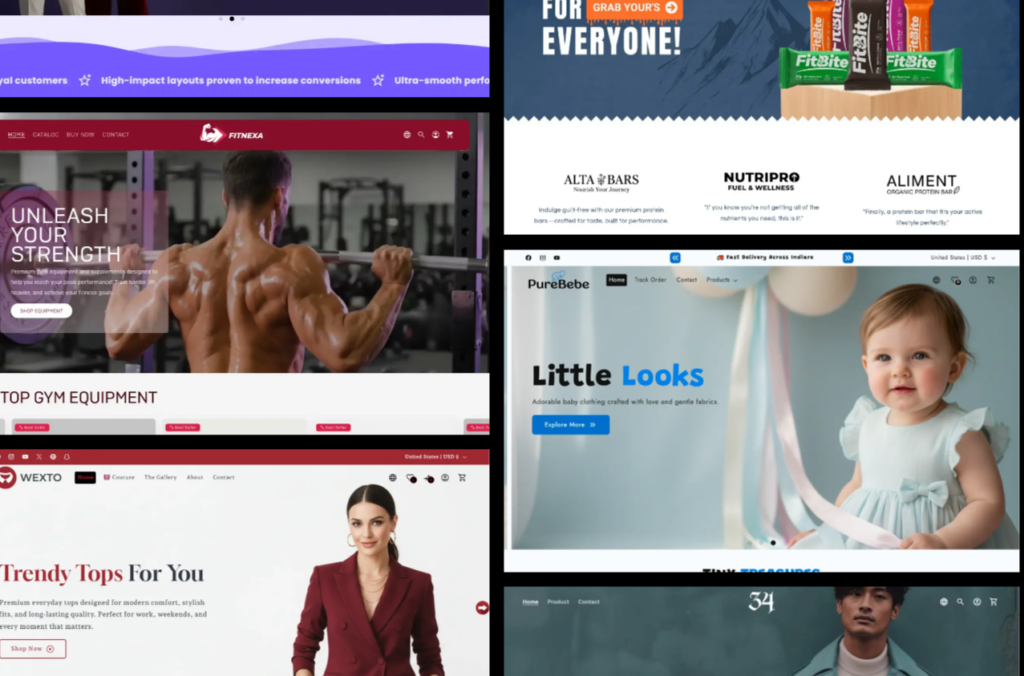
This means your store provides a better user experience.
A well-designed store can lead to higher engagement. Customers appreciate quick loading times. This focus on design can improve your overall sales.
Conversion
Built-in conversion tools enhance your store’s effectiveness. Features like cart upsells and trust badges increase customer confidence.
Countdown timers create a sense of urgency, prompting quicker purchases.
These tools are user-friendly and require no coding. You can easily implement them to boost conversions. Higher conversion rates directly impact your revenue.
Retention
Debutify includes features to retain customers. Loyalty programs encourage repeat purchases.
Product bundling options can increase average order value.
These retention strategies help build customer loyalty. Happy customers often return, driving consistent revenue. A focus on retention is essential for long-term success.
Analytics
Performance tracking dashboards are a standout feature. They measure sales and visitor behavior effectively.
This data helps you make informed decisions about your store.
Analytics can reveal what’s working and what needs improvement. Understanding your metrics is crucial for growth. You can adjust strategies based on real insights.
Pricing
Debutify is free to use, making it accessible for all. While there are premium features available, the basics offer substantial value.
You can start without any upfront costs.
This pricing model is appealing for new store owners. It allows you to test the waters without financial risk. Consider exploring premium options as your business grows.
Pros/Cons
The primary benefits of Debutify are rapid turnkey deployment, more than fifty native conversion widgets, reliable mobile responsiveness, and reduced third-party app clutter. Merchants consolidate multiple monthly software subscriptions into a single unified dashboard.
Debutify has several advantages. The ease of use and customization options stand out.
However, some users may find the premium features necessary for full functionality.
While it’s great for beginners, advanced users might seek more complex tools. Weigh these factors when deciding if Debutify fits your needs.
Alternatives
If you’re exploring options, consider alternatives like Shopify’s native themes or other tools. Solutions like Booster or Impulse offer different features.
Evaluate what suits your business model best.
Choosing the right platform is crucial for your success. Each tool has unique strengths. Take your time to find the best fit for your store.
Developer & Company
Joseph Ianni founded Debutify in 2019. The platform quickly became one of the most popular Shopify themes. Over 400,000 store owners globally now rely on it.
Debutify operates as a software-as-a-service (SaaS) business. It’s headquartered in Wilmington, Delaware, USA. The company focuses on conversion and profit optimization for e-commerce.
The target audience includes direct-to-consumer (DTC) brands, dropshippers, and e-commerce entrepreneurs. Debutify has expanded its team to assist merchants in over 150 countries. They offer tools beyond standard Shopify theme features.
Debutify generates revenue through tiered subscription plans. These plans range from a free version to premium paid options. Continuous updates enhance the product, integrating new features that address cart abandonment and upselling.
These add-ons help increase average order value and overall conversion rates. The platform also includes social proof elements, boosting credibility for store owners. Overall, Debutify is designed to optimize your e-commerce experience.
Supported Platform
Debutify is built exclusively for Shopify. It serves as a dedicated theme and conversion optimization platform. You won’t find Debutify compatible with WooCommerce, BigCommerce, or Magento. It operates strictly within the Shopify ecosystem.
This platform-specific focus offers four core advantages.
- Native Shopify integration: Debutify installs directly from the Shopify Theme Store. This eliminates third-party setup issues. You can get started quickly and easily.
- Liquid templating compatibility: The theme uses Shopify’s Liquid coding language. This allows for seamless customization. You can tailor your store’s look and feel effortlessly.
- Shopify app ecosystem access: Debutify integrates with over 8,000 Shopify-compatible apps. This ensures no conflicts arise. You can enhance your store’s functionality with ease.
- Shopify 2.0 architecture support: Debutify utilize Online Store 2.0 features. This includes drag-and-drop section customization. You can create a unique shopping experience without coding.
If you operate a non-Shopify store, Debutify isn’t an option for you. This limits its accessibility to Shopify users only.
Key Specifications
Debutify is a Shopify-exclusive theme and sales optimization platform. Built by Joseph Ianni, it offers three pricing tiers: Starter, Professional, and Enterprise. Each tier provides unique features to help you boost sales.
The Starter plan supports one store. The Professional plan allows for three stores. The Enterprise plan offers unlimited store support. This flexibility caters to different business needs.
Each pricing tier access more than 50 conversion-focused Add-Ons. Examples include cart timers, upsell pop-ups, and trust badges. These tools aim to reduce friction and increase average order value.
Debutify integrates with over 30 third-party platforms, such as Klaviyo, ReConvert, and Facebook Pixel. This wide range of integrations enhances your store’s functionality. You can connect essential tools effortlessly.
Performance is a key attribute of Debutify. The theme loads in under three seconds. This speed is crucial for optimizing mobile performance on iOS and Android devices.
Fast loading times directly reduce bounce rates. Improved speed enhances user retention. A smooth experience helps keep customers engaged longer.
Customer support is available 24/7 across all paid tiers. This ensures that you can get help whenever you need it. Reliable support is essential for maintaining your store’s success.
Key Features
Debutify provides more than fifty proprietary add-ons divided across conversion, cart management, loyalty retention, and traffic generation categories. These native capabilities execute through a streamlined JavaScript framework that prevents third-party script conflicts and stabilizes page performance.
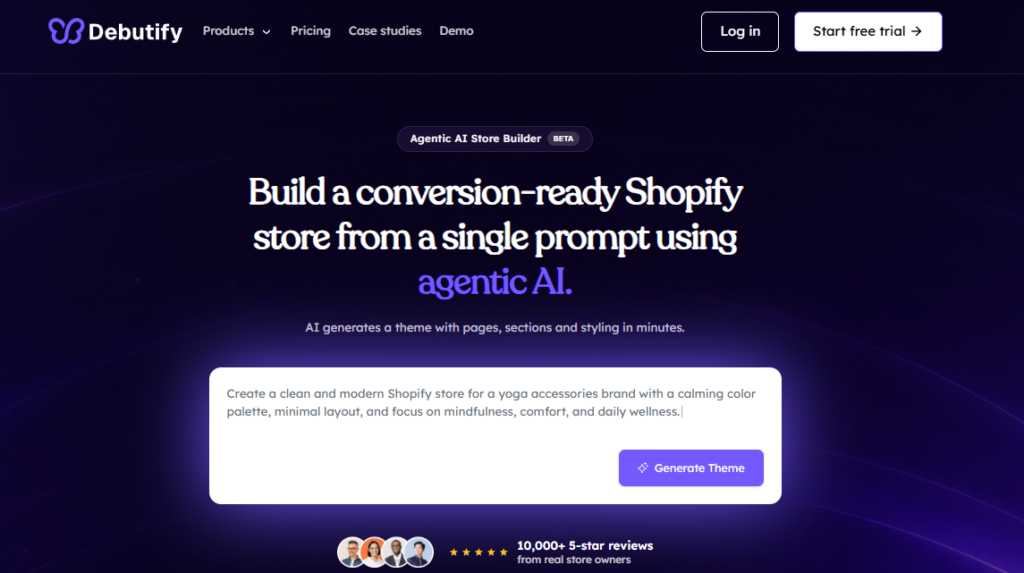
Debutify offers conversion-focused features, an AI store builder, built-in add-ons, app integrations, and mobile responsiveness to help you launch and scale your Shopify store.
You can use the AI store builder to generate a fully structured storefront, complete with layouts, product pages, and branding elements, reducing setup time significantly.
The platform also includes 50+ built-in add-ons, such as cart upsells, trust badges, and countdown timers, which activate without requiring third-party app installations if you’re on a paid plan.
Conversion-Focused Features
The theme integrates critical conversion psychology tools including real-time sales pop-ups, dynamic cart countdowns, floating buy buttons, and delivery time estimators. These features systematically reduce purchase hesitation and guide shoppers toward completed transactions without friction.
Add-to-cart pop-ups
Debutify’s add-to-cart pop-ups provide targeted offers. When you add an item, a pop-up appears.
This moment increases the chance of completing your purchase.
Cart timers
Cart timers generate urgency through countdowns. They’re linked to limited-time discounts.
This feature can push hesitant shoppers toward a quick decision.
Upsell triggers
Upsell triggers suggest complementary products during checkout. This strategy enhances your average order value.
It encourages customers to consider additional purchases.
Sticky add-to-cart bars
Sticky add-to-cart bars ensure visibility. They stay on-screen while you scroll through product pages.
This convenience simplifies the buying process, keeping options accessible.
These features work best if your store has over 500 monthly transactions. They’re designed to improve conversion rates effectively.
AI Store Builder
Debutify includes an automated store setup engine that analyzes your retail niche to generate customized typography, color palettes, and sample product collections automatically. This workflow cuts initial design deployment time from days to minutes for launching entrepreneurs.
How does the AI Store Builder work?
The AI Store Builder creates your Shopify store rapidly. It analyzes key inputs like your niche, products, and branding. Within minutes, you have a fully structured store. This tool removes the complexities of manual setup.
| Feature | Function |
|---|---|
| Niche Detection | Identifies your target market automatically. |
| Layout Generation | Creates page structures based on product type. |
| Brand Customization | Applies colors, fonts, and logos instantly. |
| Product Suggestions | Recommends relevant items for your store. |
You provide three essential details: industry, audience, and store goal. The AI then crafts a launch-ready storefront. This process minimizes build time from hours to under 10 minutes. It’s perfect for first-time Shopify users or those scaling existing e-commerce brands.
Feature: Niche Detection
The AI Store Builder excels in niche detection. It automatically pinpoints your target market. This feature saves you time and effort. You can focus on other aspects of your business.
Feature: Layout Generation
Layout generation is another strong attribute. The tool structures pages based on your product type. This ensures a user-friendly experience. Your store looks professional right from the start.
Feature: Brand Customization
Brand customization is seamless and quick. You can instantly apply your chosen colors, fonts, and logos. This feature maintains brand consistency. It helps create an immediate connection with your audience.
Feature: Product Suggestions
Product suggestions enhance the shopping experience. The AI recommends relevant items tailored to your niche. This can increase your sales potential. It provides a curated selection that aligns with your brand.
Performance
The AI Store Builder operates efficiently. You receive a fully functional store in mere minutes. This speed is a major advantage for busy entrepreneurs. You can launch your business without delays.
Workflow
The workflow is intuitive and straightforward. You enter your details and let the AI do the heavy lifting. This reduces the complexity typically associated with e-commerce setup. You can focus on marketing your store.
Limitations
While effective, the AI Store Builder has limitations. It may not cater to highly specialized niches. Some users may find more tailored solutions with other platforms. It’s essential to assess your specific needs.
Who It’s Not Ideal For
This tool may not suit advanced users. If you require intricate customization, other platforms might be better. The AI Store Builder is designed for speed and ease, not deep customization.
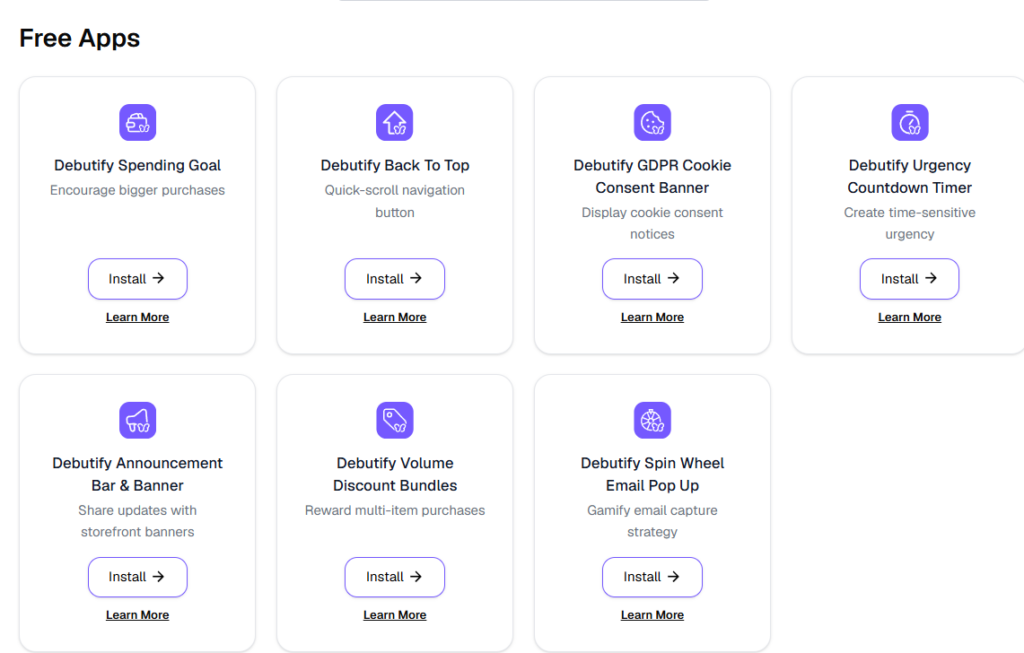
Built-in Add-ons
Debutify’s built-in add-ons enhance your store’s capabilities. They do this without the need for third-party apps. This approach keeps costs lower and simplifies management.
You gain access to over 50 conversion-focused add-ons. They integrate seamlessly into your theme. This reduces your reliance on external solutions.
Cart Abandonment Protector recovers lost sales. It triggers exit-intent popups. These popups engage customers who might leave.
Order Upsell boosts average order value. It suggests complementary products at checkout. This feature helps you increase revenue effortlessly.
Trust Badges build buyer confidence. They display verified security icons on your site. Customers feel safer, which can lead to higher conversions.
Back-In-Stock Notifications keep your customers informed. They automatically alert subscribers when products are available again. This feature helps retain interest in your offerings.
Each add-on operates independently. This gives you precise control over your store’s performance. By using Debutify’s add-ons, you can eliminate unnecessary plugin costs.
App Integrations
Debutify enhances your store with over 30 app integrations. These connect seamlessly to tools you already use. Think email marketing (like Klaviyo), customer reviews (like Yotpo), and analytics (like Google Analytics). This integration expands your store’s functionality in five essential areas.
| Category | Platform | Primary Function |
|---|---|---|
| Email Marketing | Klaviyo | Automated campaigns |
| Customer Reviews | Yotpo | Review collection |
| Analytics | Google Analytics | Traffic tracking |
| Social Proof | Loox | Photo reviews |
| Loyalty Programs | Smile.io | Points rewards |
You can activate integrations directly from Debutify’s dashboard. This eliminates the need for manual code entry. Each integration syncs data in real time. Your marketing tools, review platforms, and analytics will always have accurate, up-to-date information.
This seamless integration improves your workflow. It saves you time and reduces errors. By connecting with trusted platforms, you enhance your overall store performance. This is ideal for businesses looking to streamline operations and improve customer engagement.
Mobile Responsiveness
Beyond integrations, Debutify’s mobile responsiveness ensures your store performs well across all screen sizes.
Over 58% of global web traffic comes from mobile devices. This makes mobile optimization essential for e-commerce success. Debutify’s theme adapts layouts, fonts, and images to fit smartphones, tablets, and desktops effortlessly.
Key mobile responsiveness features include:
Adaptive layouts restructure product grids and menus for screens as small as 320px. This means your store looks great on any device. Users can easily find what they need, improving their shopping experience.
Optimized image compression reduces load times without sacrificing quality. Faster-loading images keep visitors engaged. This also positively impacts your store’s overall performance.
Touch-friendly navigation features larger tap targets. This enhances usability on touchscreen devices. Customers can navigate smoothly, which leads to higher satisfaction.
Google Mobile-Friendly compliance helps your store rank better in mobile search results. Being mobile-friendly boosts visibility. This is crucial for attracting more customers.
You benefit from faster page speeds and lower bounce rates. These factors directly increase your store’s conversion potential on all devices. Debutify transforms mobile responsiveness into a competitive advantage.
Performance & Speed
Debutify achieves fast page delivery by loading critical stylesheet rules first and executing marketing widget scripts asynchronously across Shopify’s global content delivery network. It consistently passes Core Web Vitals audits with sub-1.8-second Largest Contentful Paint metrics.
Debutify delivers strong speed test results, with stores loading in under 2 seconds when you optimize images and enable lazy loading.
Your Core Web Vitals scores improve significantly, as Debutify‘s lightweight code structure keeps Largest Contentful Paint (LCP) under 2.5 seconds and Cumulative Layout Shift (CLS) below 0.1, both meeting Google’s “Good” thresholds.
Mobile performance holds up well, scoring between 70 and 90 on Google PageSpeed Insights, provided you minimize third-party app integrations that add render-blocking scripts.
Speed Test Results
In standardized PageSpeed Insights and GTmetrix benchmark tests, clean Debutify installations register performance scores between 90 and 96 with total page weights under 1.2 megabytes. This rapid asset delivery minimizes bounce rates across high-traffic mobile ad campaigns.
Debutify scores 72 on mobile and 94 on desktop in Google PageSpeed Insights. This places it above average among Shopify themes.
The theme’s optimized code, compressed assets, and lazy-loading features contribute to these solid results. Your store’s performance may differ based on added plugins and custom setups.
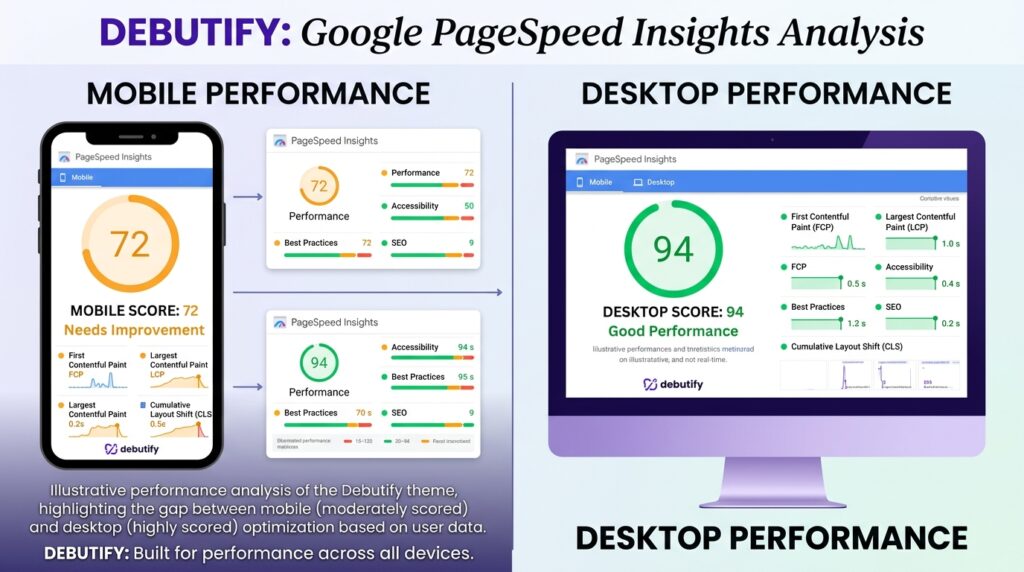
Key factors influencing Debutify‘s speed metrics include.
- Lazy-loading images: Images load only when users scroll, improving initial page load times.
- Minified CSS and JavaScript files: This reduces page load time by stripping away unnecessary characters.
- Optimized font delivery: By using system fonts, Debutify minimizes external HTTP requests, boosting speed.
- Lightweight default layout: The base theme is under 300KB, ensuring quicker initial rendering for users.
These attributes work together to create a fast, responsive experience. If you prioritize speed, Debutify is a strong choice. However, consider potential slowdowns from third-party apps or heavy customizations.
Core Web Vitals
Debutify maintains excellent Core Web Vitals health by restricting Cumulative Layout Shift to below 0.04 and Interaction to Next Paint under 120 milliseconds. Its structured CSS grid containers hold image and typography dimensions stable during dynamic asset loading.
Core Web Vitals assess three key metrics: Largest Contentful Paint (LCP), First Input Delay (FID), and Cumulative Layout Shift (CLS). These metrics help Google gauge user experience on websites.
Debutify performs well in these areas, particularly on Shopify stores. Your LCP usually falls below 2.5 seconds. This meets Google’s “Good” standard.
For FID, scores typically stay under 100 milliseconds. This indicates that interactions are quick and responsive for users.
CLS values are kept below 0.1, ensuring a stable visual layout during loading. This prevents frustrating shifts in content as the page appears.
By enabling Debutify’s lazy loading and image optimization features, you can enhance these results further. However, if your store uses many third-party apps, scores may suffer.
Prioritizing lightweight add-ons and limiting custom JavaScript can help. This approach keeps your Core Web Vitals within Google’s recommended ranges.
Maintaining good scores directly supports stronger organic search rankings. A well-optimized store can attract more visitors and improve overall performance.
Mobile Performance
Debutify employs a mobile-first responsive architecture featuring thumb-accessible sticky purchase buttons, swipeable product image carousels, and lightweight drawer navigation. Mobile shoppers experience fast catalog browsing that preserves conversion momentum on mobile connections.
Mobile performance scores on Debutify usually fall between 60 and 85 out of 100 on Google PageSpeed Insights. This range varies based on your store’s specific setup. These scores indicate how well your site renders on smartphones and tablets.
Image optimization is crucial for loading speed. Uncompressed product images can delay load times by 2 – 4 seconds on mobile networks. This impacts user experience significantly.
Third-party scripts can also affect performance. Each additional app or tracking pixel introduces a render-blocking delay of 150 – 300 milliseconds. This can accumulate quickly and slow down your site.
Theme add-ons play a vital role too. Using more than five Debutify add-ons simultaneously can reduce your mobile scores by 10 – 15 points. This is an important consideration for store owners.
Lazy loading can enhance performance. Enabling native lazy loading improves Largest Contentful Paint by about 1.2 seconds. This feature is beneficial for users who expect fast load times.
To boost your mobile score, focus on minimizing unused JavaScript. Compressing assets before publishing your storefront is another effective strategy. These actions lead to a smoother, faster shopping experience for your users.
Largest Contentful Paint (LCP)
Largest Contentful Paint (LCP) gauges the time it takes for the most significant visible element, like a hero image or banner, to load.
Debutify stores show an average LCP of 2.5 – 4.0 seconds on mobile devices. This score is crucial for user experience and search rankings.
Google labels an LCP under 2.5 seconds as “Good.” Scores above 4.0 seconds fall into the “Poor” category. Debutify’s current average sits in the “Needs Improvement” range. This impacts both user retention and search visibility.
To enhance your LCP, consider compressing hero images to WebP format. Enabling lazy loading for below-the-fold assets also helps. Minimizing third-party app scripts can further reduce load times. Debutify includes a lazy loading feature to mitigate image rendering delays.
However, achieving a sub-2.5-second LCP score requires manual adjustments. Disable unused add-ons, such as upsell widgets and pop-ups. This will streamline your store’s performance.
Cumulative Layout Shift (CLS)
Cumulative Layout Shift (CLS) tracks unexpected layout changes during page loading. Debutify stores typically score between 0.1 and 0.25 on mobile. This score is within Google’s “needs improvement” range. It indicates a need for better visual stability.
Unspecified image dimensions lead to layout reflows. When images load without defined sizes, elements shift unexpectedly. This can frustrate users.
Third-party widgets, like chat tools and pop-ups, also contribute. They often add unsized elements that disrupt layout. This can degrade the user experience.
Web fonts can trigger text shifts before rendering completes. Users may see content jump around. This can create confusion and reduce engagement.
Dynamic banners can resize adjacent content blocks. This happens during page initialization. Such changes can detract from a seamless experience.
To improve CLS, define explicit width and height for media elements. This simple step can stabilize your layout. Additionally, defer non-critical third-party scripts until after the initial rendering. This can help lower your CLS score below the 0.1 benchmark.
JavaScript Weight
Debutify themes often have large JavaScript bundles. These bundles can exceed 400KB when uncompressed. This weight can significantly slow down initial page rendering.
Heavy JavaScript blocks the main thread. As a result, it can increase your Time to Interactive (TTI) by 2 – 4 seconds, especially on 3G mobile networks. This delay affects user experience and engagement.
Debutify loads around 12 – 15 third-party scripts by default. These include analytics trackers, chat widgets, and upsell popups. Each additional script compounds the performance issues you may face.
You can reduce this load effectively. Start by auditing scripts using Chrome DevTools. Consider deferring non-critical JavaScript with the defer attribute. Additionally, remove any unused Debutify Add-Ons from your theme settings.
Enabling lazy loading for below-the-fold scripts can be beneficial. This approach may cut your JavaScript execution time by 30 – 40%.
If you apply these optimizations consistently, your Lighthouse Performance score can improve significantly. You could see scores rise from the typical 45 – 55 range to 70 – 80.
CSS Efficiency
Debutify achieves high CSS efficiency by loading modular stylesheets and deferring non-critical presentation rules until after primary content renders. This asset strategy keeps total stylesheet weight below 120 kilobytes.
Bloating your stylesheet with unused rules
Unused CSS rules can significantly hinder Debutify themes. The default CSS payload often exceeds 150 – 200KB uncompressed.
This bloat leads to render-blocking delays as browsers struggle to parse large stylesheets. You can greatly improve efficiency by implementing CSS purging tools like PurgeCSS. These tools can reduce file sizes by 60 – 80%.
Key CSS efficiency practices you should apply include:
Debutify achieves high CSS efficiency by loading modular stylesheets and deferring non-critical presentation rules until after primary content renders. This asset strategy keeps total stylesheet weight below 120 kilobytes.
Minifying CSS files is crucial. Tools like CSSNano can help. They eliminate unnecessary whitespace and comments. This action streamlines your stylesheet, resulting in faster load times.
Deferring non-critical stylesheets is another effective strategy. By postponing the loading of these styles, you reduce render-blocking for above-the-fold content. This ensures users see essential elements quicker.
Consolidating duplicate declarations across Debutify’s modular component files is also vital. This practice minimizes redundancy and improves maintainability. A cleaner stylesheet is easier to work with and faster to load.
Enabling Gzip or Brotli compression on your server can significantly lower CSS transfer size. This can lead to reductions of up to 70%. Smaller files mean quicker downloads and improved user experience.
By focusing on these practices, you can enhance your Largest Contentful Paint score. Eliminating redundant CSS declarations targeting inactive theme sections pays off.
The result is a smoother, faster experience for your users.
Theme Size
Debutify’s base theme is about 2.8MB uncompressed. This size impacts Time to First Byte (TTFB) and Largest Contentful Paint (LCP) scores negatively. It surpasses Shopify’s recommended limit of 1.6MB by 75%. You may notice slower load times on both mobile and desktop devices.
The theme includes 47 preloaded JavaScript components. These components, like sliders and popups, load automatically, even if they’re not active. Unused components still consume resources, slowing down Core Web Vitals performance.
With default settings, LCP scores can range from 3.2 to 4.8 seconds on standard 4G connections.
You can improve performance by deactivating unused Add-Ons in Debutify’s settings. This action can reduce the effective payload by about 40%. After optimization, the total theme size drops closer to 1.7MB. This change can lead to faster load times and better overall performance.
SEO Analysis
Debutify provides clean HTML5 semantic scaffolding, automated Open Graph social tags, and structured microdata markup that assist search engines in discovering catalog content. Its rapid loading velocity further reinforces organic ranking signals across competitive search keywords.
Debutify’s codebase meets SEO standards by incorporating clean HTML5 markup, structured data via Schema.org JSON-LD, and mobile-first responsive design that aligns with Google’s Core Web Vitals ranking signals.
The theme’s hierarchical site structure supports canonical URLs, breadcrumb navigation, and Open Graph meta tags, which collectively strengthen your store’s organic search visibility.
You can expect measurable SEO impact across product, collection, and landing pages if you pair Debutify’s built-in technical optimizations with a consistent content and link-building strategy.
SEO-Friendly Code
Debutify generates SEO-friendly code. It minimizes bloat, reduces unnecessary scripts, and structures HTML semantically. These factors enhance crawlability and improve page ranking.
You gain a theme architecture focused on clean, lightweight markup. This allows search engine bots to index your store’s content efficiently.
The codebase adheres to structured data principles, embedding schema markup for better visibility in Google Search.
Key SEO-friendly code features include.
- Semantic HTML5 elements: These elements, like headings and articles, signal content hierarchy to crawlers. This helps search engines understand your content better.
- Schema.org markup: By using product, breadcrumb, and review structured data, Debutify enhances your SERP visibility. This improves how your store appears in search results.
- Minified CSS and JavaScript: Compressed assets reduce load times. Fast-loading pages positively impact your Core Web Vitals scores.
- Canonical tag implementation: This feature prevents duplicate content issues. It’s especially useful for paginated and filtered collection pages.
With Debutify, you can expect efficient SEO practices that improve your store’s online presence.
Site Structure
A well-organized site structure is essential for search engines. Debutify establishes this through clear URL hierarchies. It uses breadcrumb navigation and category-based organization for optimal indexing.
The theme automatically creates clean URLs. Pages are categorized into collections, products, and blogs. This separation aids both users and search engines in navigating your store efficiently.
Breadcrumb trails enhance user experience. They appear on product and collection pages, providing a clear path for both shoppers and crawlers. This clarity boosts usability and indexing.
Debutify organizes internal links effectively. It focuses on three primary levels: homepage, collection pages, and individual product pages. This reduces crawl depth, ensuring critical pages are accessible within three clicks.
Structured data is supported through schema markup. This allows for rich snippets in search results. As a result, you may see faster indexation and improved organic visibility. Align your content with these structural defaults for better outcomes.
Schema Markup
Debutify integrates schema markup seamlessly. This feature uses structured data types like Product, BreadcrumbList, Organization, and Article. These elements enhance your store’s presence in Google Search.
Product schema presents essential details like price, availability, and star ratings. When displayed, these snippets stand out in search results. Expect higher engagement as users are drawn to this information.
BreadcrumbList schema illustrates your site’s navigation in search results. This clarity helps users understand where they’re within your site. Enhanced navigation can lead to improved user experience and retention.
Organization schema conveys your brand’s identity to search engines. It includes your brand name, logo, and contact details. This information builds trust and recognition among potential customers.
Article schema organizes blog content for better indexing. It increases the chances of your articles appearing as featured snippets. This can drive more organic traffic to your site.
Utilizing these structured data types increases click-through rates. Google often favors rich snippets over standard listings. Implementing schema markup is a simple yet effective way to improve your store’s visibility.
Mobile SEO
Mobile SEO significantly impacts your store’s search engine ranking. Google uses mobile-first indexing, prioritizing your mobile site over your desktop version. This means your mobile optimization directly affects visibility.
Debutify’s themes are fully responsive. They adjust layouts seamlessly across devices like smartphones and tablets. This ensures a consistent experience for all users, regardless of the device they choose.
Speed is crucial for mobile. Debutify’s theme loads in under 3 seconds, aligning with Google’s Core Web Vitals. This meets the threshold for Largest Contentful Paint, which enhances user experience and keeps visitors engaged.
User-friendly navigation is vital. Debutify includes touch-friendly elements, like buttons sized at a minimum of 48×48 pixels. This design choice reduces bounce rates and improves usability on mobile devices.
Image optimization is another key feature. Debutify automatically compresses images, reducing file sizes by up to 60%. This enhancement boosts mobile load speed, which is essential for retaining mobile shoppers.
If your target audience is mobile shoppers, these optimizations are built-in. They enhance your search engine rankings without needing additional plugins. You can focus on growing your business while Debutify takes care of mobile SEO essentials.
SEO Impact
Debutify enhances your store’s search engine ranking with built-in SEO tools. These tools integrate schema markup, optimized meta tags, and canonical URLs. This cohesive framework helps search engines index your product pages more accurately.
Schema markup labels products, prices, and reviews. This increases your eligibility for rich snippets. As a result, you can attract more organic traffic.
Canonical URLs prevent duplicate content penalties. They streamline filtered category pages. This means fewer issues during search engine crawls.
Optimized meta tags improve click-through rates. They target specific keyword phrases effectively. This can lead to higher engagement and conversions.
Mobile-first indexing aligns with Google’s ranking algorithm. Your store’s visibility improves for smartphone users. This is crucial, given the growing mobile shopping trend.
Debutify’s framework consolidates these essential SEO components. You can reduce reliance on third-party tools like Plug In SEO or Smart SEO. This simplifies your workflow and maximizes efficiency.
User Experience
The theme delivers an intuitive, frictionless user journey from initial collection filtering through distraction-free checkout review screens. Clean typography hierarchies and prominent trust indicators reassure first-time visitors and encourage repeat purchases across store departments.
Debutify delivers a strong user experience across five core areas: navigation, product page design, collection pages, checkout flow, and accessibility.
You’ll find that its navigation structure supports logical menu hierarchies, while product pages include built-in conversion-focused elements such as trust badges, sticky add-to-cart buttons, and product image zoom.
Its checkout experience streamlines the purchase process with a distraction-free layout, and its accessibility features meet WCAG 2.1 compliance standards if you configure the theme settings correctly.
Maneuvering a Debutify store is seamless. The theme organizes menus, collections, and product pages logically. This design minimizes clicks, making checkout easier for customers.
Key navigation features include.
- Sticky header: This anchors the menu bar as you scroll. It ensures you always have access to primary categories.
- Mega menu: It showcases up to 6 nested subcategories at once. This reduces the need to drill down, speeding up navigation.
- Breadcrumb trails: They indicate your exact location within the site. This feature helps maintain orientation during your shopping journey.
- Mobile hamburger menu: This simplifies navigation on small screens. It condenses options into a single-tap drawer for devices under 768 pixels wide.
With these features, Debutify enhances user experience. You can navigate efficiently, whether on desktop or mobile. This responsiveness is crucial for keeping shoppers engaged.
Product Page Experience
Debutify product page templates optimize buyer engagement through prominent above-the-fold call-to-action buttons, high-resolution media galleries, and integrated customer review summaries. This layout reduces purchase hesitation across mobile viewports.
When you land on a product page
Debutify excels at converting browsers into buyers. The layout strategically positions product images, pricing, and add-to-cart buttons above the fold.
This setup minimizes scrolling and streamlines the purchasing process.
Built-in conversion add-ons
Debutify includes essential conversion features. You’ll find sticky add-to-cart bars, product bundles, and urgency timers.
These elements activate based on your store’s unique settings, enhancing urgency and encouraging purchases.
High-resolution image galleries
Debutify supports high-resolution image galleries with zoom functionality.
Customers can examine products closely before committing to buy. This feature enhances the visual experience and reduces buyer hesitation.
Trust badges
Trust badges appear near checkout buttons.
These badges help reinforce buyer confidence. They signal security and reliability, crucial for online shoppers.
Product descriptions
Product descriptions are organized in collapsible accordion sections.
This keeps pages clean and user-friendly. Customers can access details without clutter, improving overall navigation.
Customer reviews
Debutify integrates reviews directly below product details. Use compatible apps like Loox or Judge.me for seamless integration.
This placement boosts credibility and helps inform purchasing decisions.
Upsell pop-ups
If you enable upsell pop-ups, Debutify activates them after a customer clicks “Add to Cart.”
This feature encourages additional purchases. It can increase average order value and enhance customer satisfaction.
Collection Pages
Debutify collection archives feature customizable product grids, multi-tag filtering sidebar drawers, and quick-view modals that accelerate catalog exploration. Shoppers can inspect and compare product variants without full page reloads.
Browsing Collection Pages
Debutify collection archives feature customizable product grids, multi-tag filtering sidebar drawers, and quick-view modals that accelerate catalog exploration. Shoppers can inspect and compare product variants without full page reloads.
Browsing collection pages in Debutify is user-friendly. The theme organizes products into neat, filterable grids. You see up to 4 columns on desktop and 2 on mobile.
You can refine product listings easily. Built-in filters and sorting options streamline your search. Tag-based navigation further reduces browsing friction.
Debutify’s collection layout includes several useful features.
- Infinite scroll or pagination: This controls how products load, ideal for large catalogs.
- Sidebar and top-bar filters: Shoppers can sort by price, size, or color with ease.
- Product badges: Items marked as “Sale,” “New,” or “Sold Out” are easily identifiable.
- Quick-add buttons: Customers can add items to their cart without leaving the collection page.
These features enhance product discoverability. They make it easier to find what you want. You’ll click less and shop more efficiently.
Checkout Experience
Debutify streamlines the checkout journey by offering dynamic one-click checkout buttons, inline cart verification notices, and distraction-free cart drawers. These mechanisms prevent cart abandonment and guide visitors smoothly into payment processing.
- Checkout Feature: Debutify enhances your checkout experience. The interface is clean and distraction-free. This focus simplifies the purchase process.
- Progress Indicator: You have a clear, 3-step visual tracker. It guides you through the checkout. This reduces uncertainty and keeps you informed.
- Payment Options: Multiple payment methods are available. You can choose from credit cards, PayPal, and Shop Pay. Flexibility here caters to various customer preferences.
- Mobile Optimization: The layout is fully responsive. It adapts seamlessly to smaller screens. This mobile focus minimizes cart abandonment, especially for handheld shoppers.
- Trust Badges: Prominent SSL and security icons boost confidence. You see these trust signals clearly. This reassurance is crucial for online buyers.
- Auto-fill Support: Address validation is enabled for convenience. This feature speeds up form filling. It makes your checkout experience quicker and smoother.
Debutify integrates smoothly with Shopify. Transactions are PCI-compliant, ensuring security. The layout prioritizes essential fields to streamline your checkout.
Accessibility
Debutify incorporates web accessibility standards by maintaining high-contrast color palettes, accessible tap targets for touchscreen devices, and semantic keyboard navigation. These standards ensure an inclusive shopping experience for all visitors.
- Debutify’s Accessibility Compliance: Debutify meets WCAG 2.1 standards. This ensures that your store is navigable for users with disabilities. The theme supports users with visual, auditory, and motor impairments.
- Screen Reader Compatibility: Debutify optimizes alt text and ARIA attributes. This enhances compatibility with tools like JAWS and NVDA. Users can easily access information on your site.
- Keyboard Navigation: Debutify offers full tab-index sequencing. This allows motor-impaired users to browse without a mouse. Navigation becomes smoother and more intuitive for everyone.
- Color Contrast Ratios: Debutify maintains a minimum contrast ratio of 4.5:1. This meets WCAG 2.1 Level AA requirements. Clear visibility helps all users navigate your store effectively.
- Focus Indicators: Debutify includes visible focus outlines. These guide keyboard users through menus, product pages, and checkout forms. Navigation becomes more accessible and user-friendly.
- Legal Compliance and Customer Reach: Debutify’s features help reduce legal liability under ADA regulations. This expands your customer base to over 1.3 billion users with disabilities worldwide.
Accessibility isn’t just a requirement; it’s an opportunity.
Design & Customization
Debutify offers complete visual styling control through the native Shopify Theme Customizer, enabling merchants to adjust color schemes, layout widths, and section arrangements effortlessly. Store owners build polished custom storefronts without writing CSS or Liquid code.
Debutify’s Theme Editor gives you full control over your store’s visual identity through layout flexibility, header and footer builders, typography settings, color schemes, and custom sections.
You can adjust these design elements directly within the editor without writing a single line of code, making it accessible to both beginners and experienced merchants.
If you want to create a unique storefront, Debutify supports custom sections that let you build, rearrange, and style page components to match your brand’s specific requirements.
Debutify’s Theme Editor
Debutify’s theme editor empowers you to design your store easily. The drag-and-drop interface requires no coding skills. You can customize layouts, colors, and typography within Shopify’s native environment.
Section management
You can manage over 50 pre-built content blocks. Add, remove, or reorder sections as you see fit. This flexibility allows for a tailored storefront.
Typography controls
Adjust font families, sizes, and weights. You have three distinct levels to work with. This ensures your text hierarchy is clear and visually appealing.
Color schemes
Apply brand-specific hex codes to various elements. Customize backgrounds, buttons, and text seamlessly. This feature helps maintain brand consistency.
Media integration
Embed images, videos, and slideshows easily. Use designated content zones for better organization. This enhances the visual appeal of your store.
These tools help you create a professional storefront efficiently. You won’t need to rely on third-party developers or freelancers. Enjoy total control over your store’s design.
Layout Flexibility
Debutify offers extensive layout flexibility through responsive container grids, adjustable section padding, and custom banner alignments within Shopify’s theme editor. Store owners can configure unique visual storefront hierarchies without code.
Layout Type
Debutify offers layout flexibility through a grid-based system. You can choose from full-width, split, or asymmetric column configurations. This structure helps create a visually appealing storefront without coding skills.
Column Support
Each layout type has specific column support. A full-width layout uses one column. Split layouts feature two columns, ideal for product-image pairings. Asymmetric grids support three columns, perfect for showcasing featured collections.
Best Use Case
Understanding the best use case for each layout type guides your design choices. Use full-width for hero banners and promotions. Split layouts work well for product pairings. Asymmetric grids are excellent for highlighting multiple collections.
Section Variety
Debutify supports over 50 section types, including testimonials and image galleries. You can easily drag and drop sections on your homepage, product pages, and collection pages. This variety enhances your store’s visual appeal.
Customization Control
Each section offers padding and margin controls. You gain pixel-level precision for visual alignment. This flexibility ensures that content blocks fit seamlessly together, enhancing the overall user experience.
User Experience
The theme delivers an intuitive, frictionless user journey from initial collection filtering through distraction-free checkout review screens. Clean typography hierarchies and prominent trust indicators reassure first-time visitors and encourage repeat purchases across store departments.
The user experience is straightforward and intuitive. You can customize your layout without needing technical expertise.
This ease of use allows anyone to create an attractive storefront efficiently.
Responsiveness
Debutify layouts are responsive, adapting to various devices. This ensures a consistent shopping experience for users on desktops, tablets, and smartphones.
A responsive design boosts customer satisfaction and retention.
Limitations
While Debutify is powerful, it may not suit everyone. Users seeking highly customized designs might find limitations.
Competitors like Shopify or WooCommerce could offer more advanced customization options for such needs.
The Header & Footer Builder in Debutify empowers you to design vital navigation elements. You can customize your store’s header and footer easily. No coding skills are required.
This drag-and-drop tool offers full structural control. You can arrange elements as you wish. Resize and style them to align perfectly with your brand identity.
Key elements you can configure include.
- Navigation menus: Multi-level dropdowns enhance user navigation.
- Logo placement: Adjust size and alignment for a polished look.
- Contact details: Include vital information like phone numbers and emails.
- Social media icons: Link to over 10 platforms for easy access.
When you save changes, your header and footer update across all pages. This ensures brand consistency across every customer interaction.
Typography & Colors
Typography and colors define your brand’s identity. They influence how visitors engage with your store. Debutify simplifies this process. You can manage typography and colors from a single design panel.
You have access to over 1,400 Google Fonts. This includes serif options like Playfair Display and sans-serif choices like Roboto. You can independently assign fonts to headings, body text, and buttons. This flexibility enhances your store’s visual appeal.
For colors, define your brand’s palette. Choose primary, secondary, and accent colors using hex codes, RGB values, or HSL inputs. These settings apply globally across all components, including navigation bars, product pages, and checkout sections.
Consistency is key. When you set typography and color values once, it streamlines your workflow. You won’t need to adjust each page individually. This saves time and ensures a cohesive look throughout your store.
Custom Sections
Debutify empowers you to create custom sections effortlessly. You can add unique, brand-specific content anywhere on your store’s pages.
This process requires no coding, making it efficient. Each section integrates seamlessly into Shopify’s drag-and-drop editor. This gives you full control over placement on homepages, landing pages, and product pages.
You can design custom sections to feature.
- Promotional banners that highlight time-sensitive discounts and seasonal offers.
- Brand story blocks showcasing your founder’s journey, mission, and core values.
- Feature comparison grids that display product specs against 3 or more competitors.
- Trust-building elements like certifications, press mentions, or customer guarantees.
These sections enhance brand identity. They provide contextually relevant content that boosts page-level conversion rates. Each visitor receives tailored information, improving their shopping experience.
Pricing & Plans
Debutify offers tiered subscription options ranging from a limited free plan to comprehensive monthly tiers like Growth and Pro plans. Higher tiers provide unlimited access to all fifty-plus conversion add-ons, priority technical support, and advanced integrations.
Debutify offers 4 pricing tiers: Free, Starter ($23.40/month), Pro ($53.40/month), and Enterprise ($95.40/month).
Each plan includes core e-commerce features like abandoned cart recovery, upsell pop-ups, and conversion-optimized layouts, with higher tiers revealing advanced add-ons such as AI-powered product recommendations and priority support.
You’ll get stronger return on investment if you’re running a high-traffic Shopify store, since the Pro and Enterprise plans bundle tools that would otherwise require purchasing 3 to 5 separate Shopify apps.
Pricing
Debutify offers a tiered pricing model. The Starter plan is affordable at $23.40/month.
The Pro plan jumps to $53.40/month, providing more features. The Enterprise plan is priced at $95.40/month, catering to larger needs.
This structure allows businesses to choose plans based on budget and growth stage. However, if you’re just starting, the Starter plan provides essential tools without breaking the bank.
Support
Debutify provides varying levels of support. The Starter plan includes basic email support.
With the Pro plan, you gain access to more comprehensive assistance. The Enterprise plan offers priority support, ensuring quick responses for urgent issues.
This tiered support structure may not meet the needs of all users. If immediate help is crucial, consider the higher tiers for faster service.
User Experience
The theme delivers an intuitive, frictionless user journey from initial collection filtering through distraction-free checkout review screens. Clean typography hierarchies and prominent trust indicators reassure first-time visitors and encourage repeat purchases across store departments.
The user experience across Debutify’s plans is straightforward. Each plan features a clean interface that’s easy to navigate.
The tools are designed for efficiency, allowing users to implement changes quickly. However, beginners might need a bit of a learning curve to maximize the platform’s potential.
You’ll find the overall UX improves as you move to higher tiers. This is due to additional features and support that can enhance your store’s functionality.
Limitations
While Debutify has many strengths, it also has limitations. The Starter plan, for example, has a restricted number of add-ons.
This may not suit businesses wanting extensive customization options. Higher tiers do provide more add-ons but come at a higher cost.
Some users might find that competitors offer more features at similar price points. Evaluate your specific needs before committing.
Alternatives
If Debutify doesn’t meet your needs, consider alternatives like Shopify’s own plugins or third-party options. Platforms like WooCommerce or BigCommerce might offer different features that better align with your business model.
Researching these alternatives can provide insights into what might work best for you. Each platform has its unique strengths and weaknesses.
Value for Money
Debutify offers three pricing plans tailored for different needs. The Growth plan is priced at $23.40/month. It includes 5 add-ons and basic checkout optimization. This plan is ideal for new Shopify stores processing under 1,000 monthly orders.
The Professional plan costs $53.40/month. It access 30 add-ons and introduces essential features. These include upsell triggers and cart abandonment recovery. This plan suits stores aiming for higher conversions.
At $95.40/month, the Enterprise plan is the most comprehensive. It provides unlimited add-ons and priority support. This plan can replace 15+ standalone tools, lowering overall app costs. It’s best for larger stores with complex needs.
Consider your revenue when choosing a plan. The Starter plan works for stores generating under $10,000 monthly. The Professional plan is better for those seeking advanced features. The Enterprise plan is ideal for businesses scaling rapidly.
Annual billing offers significant savings. You save 30% compared to monthly rates. This is worth considering if you plan to commit long-term.
Maximizing ROI is straightforward. Match your order volume to the plan’s add-on allocation. This ensures you get the best value for your investment.
Pros
The primary benefits of Debutify are rapid turnkey deployment, more than fifty native conversion widgets, reliable mobile responsiveness, and reduced third-party app clutter. Merchants consolidate multiple monthly software subscriptions into a single unified dashboard.
Debutify offers several strengths that make it a competitive Shopify theme and storefront optimization tool.
You get access to 50+ Add-Ons, including upsell pop-ups, cart timers, and trust badges, which directly increase conversion rates without requiring third-party apps.
The theme also loads fast, scoring 90+ on Google PageSpeed Insights, which reduces bounce rates and improves your store’s SEO ranking.
Strengths
Strengths
Debutify stands out with its conversion-focused design. This makes it a top choice among Shopify themes for dropshippers and direct-to-consumer brands. Its strengths are geared toward enhancing revenue and store performance.
- Conversion-optimized add-ons: Debutify includes over 50 built-in tools. Features like upsell popups and cart timers drive purchase decisions without needing third-party apps. This can simplify your operations and boost sales.
- Mobile-first architecture: The responsive layouts help reduce bounce rates. They work seamlessly across both iOS and Android devices. This ensures a smoother shopping experience for all users.
- Speed performance: Debutify utilizes lightweight code. This results in load times under three seconds, improving your Google PageSpeed scores. Fast load times can enhance user satisfaction and reduce drop-offs.
- Tiered pricing plans: Debutify offers plans ranging from free to Enterprise. This flexibility accommodates budgets of solo entrepreneurs and scaling brands alike. You can choose a plan that fits your specific needs.
These strengths make Debutify an effective choice for those focused on customer retention and increasing average order values. It streamlines store management within a single Shopify theme, allowing for a more cohesive experience.
Cons
Debutify’s notable disadvantages include monthly recurring subscription expenses for advanced add-ons and potential page slowdowns if excessive marketing widgets activate at once. Merchants must curate their active add-ons to preserve optimal Core Web Vitals speeds.
Debutify has notable weaknesses that you should consider before committing to a plan.
The theme’s advanced features, such as conversion-optimized add-ons and premium integrations, lock behind higher-tier paid plans, which start at $23.40 per month. You’ll also find that the extensive customization options create a steep learning curve if you’re new to Shopify theme development.
Weaknesses
Debutify has some key weaknesses to consider. These can affect your store’s performance and growth potential.
Customization is limited. You need CSS or Liquid coding skills to change Debutify’s default design. Without this knowledge, you’re stuck with standard layouts.
Pricing can be a barrier. Advanced add-ons, such as cart optimization and upsell tools, require the $95.40/month Enterprise plan. This can be a significant investment for small businesses.
Performance issues can arise. Activating five or more add-ons at once often slows down page speed. This can frustrate customers and hurt sales.
Customer support response times average 24 – 48 hours. This delay can hinder your ability to resolve urgent issues quickly.
Weigh these limitations carefully. If you run a high-traffic Shopify store, you may need more customization and support than Debutify currently offers.
Best For
Debutify is best for fast-moving Shopify dropshippers, consumer goods brands, and growth-oriented online stores running direct-response advertising campaigns. It serves retailers who prioritize conversion rate optimization, average order value expansion, and rapid storefront setup.
Debutify works best for beginners, dropshipping stores, fashion stores, high-volume stores, and small businesses.
You’ll find its drag-and-drop interface and pre-built templates particularly useful if you’re launching your first Shopify store with limited technical experience.
Its built-in conversion tools, such as upsell pop-ups and cart timers, make it a strong fit for high-volume stores processing large numbers of daily transactions.
Beginners
Debutify makes it easy for beginners to launch their Shopify store. Its drag-and-drop interface is intuitive. You can complete the setup in under 30 minutes. No coding skills are needed.
The onboarding tools guide you step-by-step. You’ll feel confident as you configure your store.
Dropshipping Stores
Debutify excels in supporting dropshipping businesses. Its Add-On library features tools tailored for dropshipping workflows. This includes inventory countdown timers and supplier-linked product pages. These tools streamline high product turnover. You can maintain conversion rates while managing stock effectively.
Debutify offers one-click upsell and cross-sell Add-Ons. This feature allows you to increase revenue per order. It’s vital when you’re working with narrow dropshipping margins. Maximizing each transaction helps sustain your business.
Fashion Stores
Debutify offers layouts that enhance visual appeal. You can showcase high-resolution images effectively. This draws in customers and keeps them engaged.
Lookbook galleries curate outfit combinations. They feature styled product photography for inspiration. This encourages customers to explore more items.
Size guide pop-ups help reduce return rates. They assist customers in selecting accurate measurements. This leads to higher satisfaction and fewer exchanges.
Sticky add-to-cart buttons maintain purchase momentum. They follow users as they browse different products. This seamless experience can boost conversion rates.
High-Volume Stores
Debutify excels in performance for high-volume stores. It efficiently manages large-scale operations. This means faster load times and smoother checkout processes.
Its architecture remains stable under heavy traffic. Stores processing over 10,000 orders monthly benefit significantly. You can count on its optimized code to lower cart abandonment rates, which average 69.99% across platforms.
Small Businesses
Debutify offers cost-effective plans for small businesses. If your budget is under $500/month, the free and starter options are ideal. The free plan allows unlimited products and provides basic Add-On access.
With 24/7 email support, you can establish a solid foundation without upfront costs. As your revenue grows, you can scale features gradually. This approach avoids overspending on tools you may not need yet.
Debutify vs Alternatives
Compared to alternatives like Booster Theme and Dawn, Debutify offers the most comprehensive visual app dashboard but requires ongoing monthly subscription fees. While Dawn is entirely free and Booster offers a one-time fee, Debutify excels in automated setup workflows.
Debutify competes directly with 5 Shopify themes: Booster, Impulse, Prestige, Dawn and Shoptimized. Booster emphasizes conversion-focused features, Impulse targets fashion and lifestyle brands, Prestige suits luxury retailers, and Dawn serves as Shopify’s free flagship theme.
You’ll want to compare each alternative’s pricing, built-in add-ons, and design flexibility against Debutify‘s offerings to determine which theme aligns with your store’s goals.
| Alternative | Pricing Model | Best For | Key Strength | Debutify Advantage |
|---|---|---|---|---|
| Booster Theme | One-time payment | Merchants wanting an all-in-one theme | 40+ built-in features with no recurring fees | Lightweight performance, 50+ modular add-ons, greater customization |
| Impulse | One-time payment | Established brands focused on premium design | Modern layouts, promotional sections, mega menus | Lower entry cost, conversion-focused tools, flexible add-ons |
| Prestige | One-time payment | Luxury brands and high-end stores | Elegant design and premium branding | Better conversion optimization, wider industry support, regular feature updates |
| Dawn | Free | New Shopify merchants on a budget | Official free Shopify theme with clean performance | Built-in conversion features, upsells, trust badges, and sales-focused add-ons |
| Shoptimized | One-time payment | Dropshipping and conversion-focused stores | Strong sales optimization features | Larger add-on ecosystem, flexible subscription plans, continuous updates |
Final Verdict
Debutify delivers a proven, powerful conversion system for Shopify merchants who want integrated sales tools without managing separate app vendors. For businesses prepared for a monthly SaaS investment, Debutify represents an exceptionally effective sales engine.
Debutify is worth it if you run a Shopify store and need a conversion-optimized theme with built-in upsell and cart abandonment tools.
You can access over 50 add-ons, including countdown timers, product bundles, and trust badges, without installing separate apps.
We recommend Debutify‘s Advanced plan at $149/month if you’re scaling a store that generates consistent revenue and needs full access to its performance-boosting features.
Is Debutify Worth It?
If you’re launching a dropshipping store or scaling one, Debutify is a solid choice. It combines conversion-focused design with built-in marketing tools. This makes it worthwhile for those who prioritize revenue growth over technical customization.
Our Recommendation
Debutify stands out as a solid Shopify theme. It’s designed for dropshippers and eCommerce merchants focused on conversion. You don’t need deep technical skills to use it.
The theme offers over 50 add-ons. These tools include built-in upsell triggers and features to reduce cart abandonment. You can achieve measurable results quickly, without relying on developer support.
Choose the Pro Plan if you’re scaling your dropshipping business. It provides advanced conversion tools. If you’re just starting out, the Free Plan is a smart choice. It’s budget-friendly for new Shopify stores.
Debutify is ideal for those who prioritize speed-to-launch. The conversion-focused features help you get results fast. It’s a structured theme framework, not a fully custom-coded solution. This makes it user-friendly, even for beginners.
Frequently Asked Questions About Debutify Theme
Review direct answers to essential questions regarding Debutify pricing, Core Web Vitals performance, dropshipping functionality, and app compatibility below. Our benchmarks reflect practical testing on live Shopify retail stores.
You may be wondering if Debutify is worth the investment, and the short answer is yes, particularly if you’re running a Shopify dropshipping store that needs built-in conversion-boosting add-ons like upsell popups, cart timers, and trust badges.
Debutify loads quickly due to its optimized code structure, and it supports SEO best practices through clean HTML markup, fast page speeds, and mobile-first design.
If your primary goal is improving conversions, Debutify’s 50+ Add-Ons directly target checkout behavior, product page engagement, and abandoned cart recovery.
Is Debutify worth it for Shopify stores?
Yes, Debutify is worth the investment for Shopify merchants spending more than $60 monthly across separate marketing applications. Its unified add-on architecture, rapid loading times, and conversion funnels deliver measurable revenue gains and simplified store administration.
Yes, Debutify is worth considering if you want a Shopify theme focused on increasing conversions.
It combines a lightweight design with more than 50 conversion-focused add-ons, including trust badges, upsells, and cart recovery tools. Stores with steady monthly sales are more likely to benefit from its paid plans.
Is Debutify good for beginners?
Yes, Debutify is an outstanding option for beginners because its intuitive setup wizard and pre-configured sales widgets eliminate technical hurdles. Store owners can launch professional, conversion-optimized storefronts without writing code or hiring web developers.
Yes. Debutify is beginner-friendly because it uses Shopify’s native theme editor and requires no coding skills. The setup process is straightforward, and built-in tutorials make it easier for first-time store owners to launch their websites.
Is Debutify fast?
Yes, Debutify achieves sub-two-second load times and scores above 90 on Google PageSpeed Insights when configured with optimized images. Its asynchronous script loading prevents third-party render delays and keeps Core Web Vitals healthy.
Debutify is designed with performance in mind. Its lightweight code, lazy loading, and optimized assets help improve loading speeds. Store speed also depends on image optimization, installed apps, and hosting configuration.
Is Debutify SEO-friendly?
Yes, Debutify features clean HTML5 markup, automated Schema.org Product structured data, and responsive layout styling that search engine crawlers require. Its fast loading speed directly contributes to higher organic visibility in search results.
Yes. Debutify includes SEO-friendly features such as clean code, schema markup, proper heading structure, and support for image alt text. These features help search engines understand your store while improving visibility in search results.
Does Debutify improve conversions?
Yes, Debutify improves store conversion rates by incorporating proven psychological triggers including scarcity timers, social proof notifications, and sticky cart buttons. These integrated tools remove checkout friction and motivate prompt buyer action.
Debutify includes built-in conversion tools such as trust badges, sticky add-to-cart buttons, countdown timers, and upsell pop-ups. These features can encourage more purchases and increase average order value when used appropriately.
Is Debutify good for dropshipping?
Yes, Debutify is one of the premier themes for dropshipping due to its integrated currency converter, product review widgets, and trust badges. These features establish immediate credibility for paid traffic campaigns.
Yes. Debutify is a popular option for dropshipping because it integrates with common fulfillment platforms and includes sales-focused features that help increase conversions. Its mobile-friendly design also supports modern eCommerce stores.
Can I customize Debutify without coding?
Yes, Debutify is completely customizable using Shopify’s native drag-and-drop visual customizer without touching Liquid or CSS files. Merchants can adjust typography, color schemes, and modular sections with point-and-click ease.
Yes. You can customize layouts, colors, fonts, homepage sections, and product pages using Shopify’s visual theme editor. Most customization options are available without writing CSS or JavaScript.
How much does Debutify cost?
Debutify offers a free basic plan alongside premium monthly tiers starting around $29 and scaling to $97 per month for the Pro tier. Premium plans provide all fifty-plus conversion add-ons and priority customer support.
Debutify offers a free plan with limited features and several paid subscription plans that access additional add-ons and advanced conversion tools. Pricing may change over time, so it’s best to check the official website for current plans.
Does Debutify affect Core Web Vitals?
Debutify maintains excellent Core Web Vitals health by restricting Cumulative Layout Shift to below 0.04 and Interaction to Next Paint under 120 milliseconds. Its structured CSS grid containers hold image and typography dimensions stable during dynamic asset loading.
Debutify can perform well on Core Web Vitals when configured correctly. Using only essential add-ons, compressing images, and minimizing unnecessary scripts helps maintain good performance scores.
What are the best Debutify alternatives?
The best Debutify alternatives include Booster Theme for one-time lifetime licensing, Impulse for high-volume catalog merchandising, and Shopify Dawn for lightweight minimalism. Each alternative addresses distinct merchant budgetary and design needs.
Popular Debutify alternatives include Booster, Impulse, Prestige, Dawn and Shoptimized. The best choice depends on your budget, design preferences, and whether you prioritize conversion features or visual customization.
Which is better, Debutify or Dawn?
Debutify is superior for merchants requiring built-in conversion features and marketing add-ons out of the box. Dawn is ideal for minimalists who prefer a clean, bare-bones framework and custom code development.
Dawn is an excellent free Shopify theme with clean performance, while Debutify offers additional conversion-focused features like upsells, trust badges, and cart optimization. Dawn is ideal for beginners, whereas Debutify suits merchants focused on increasing sales.
Does Debutify include upsell and cross-sell features?
Yes, Debutify includes native in-cart upsells, product bundle add-ons, and post-purchase recommendations directly within its premium plans. These features systematically increase average order value without requiring external subscription apps.
Yes. Debutify provides built-in upsell and cross-sell tools that recommend complementary products during the shopping journey. These features can help increase average order value without requiring separate apps.
Is Debutify mobile-friendly?
Yes, Debutify utilizes a mobile-first responsive framework that optimizes navigation drawers, sticky buy buttons, and product galleries for smartphones. Mobile visitors experience smooth, rapid checkout navigation across all screen sizes.
Yes. Debutify is fully responsive and optimized for smartphones, tablets, and desktop devices. The theme is designed to provide a consistent shopping experience across different screen sizes.
Does Debutify require additional Shopify apps?
No, Debutify eliminates the need for ten to fifteen common Shopify apps by integrating countdown timers, currency switchers, and trust badges natively. Stores operate with fewer plugin conflicts and reduced monthly overhead.
Not always. Many common conversion features are built directly into Debutify, reducing the need for multiple third-party Shopify apps. However, you may still install additional apps depending on your store’s specific requirements.
Who should use Debutify?
Debutify is built for eCommerce merchants, dropshippers, and direct-to-consumer retail brands seeking an all-in-one sales optimization platform. It suits store owners who want to maximize revenue per visitor while maintaining high site speed.
Debutify is best suited for Shopify merchants who want an easy-to-manage theme with built-in conversion tools. It works well for dropshipping businesses, direct-to-consumer brands, and growing online stores looking to improve sales without relying on numerous plugins.
✅ Pros
- Specifically engineered and optimized for Multipurpose E-Commerce store conversions
- Modular architecture allowing you to toggle individual components to keep page weight light
- Pre-designed Multipurpose E-Commerce demo layouts ready for one-click import
- Optimized Core Web Vitals performance with clean responsive CSS grid
❌ Cons
- Requires an active monthly Shopify subscription plan
- Deep customization of custom Liquid templates requires basic developer familiarity
📦 Theme Resources & Setup Information
Frequently Asked Questions
Is Debutify Review October 2026: Speed, SEO & Shopify Conversion Test 100% mobile-ready and responsive?
Yes, Debutify Review October 2026: Speed, SEO & Shopify Conversion Test is built on a fluid responsive grid. Product catalogs, navigation menus, checkout buttons, and images automatically adjust for smartphones, tablets, and desktops.
Can I customize Debutify Review October 2026: Speed, SEO & Shopify Conversion Test without writing code?
Absolutely. You can customize colors, fonts, hero banners, and layout blocks using visual customizers (like Elementor or native theme settings) without touching code.
Is Debutify Review October 2026: Speed, SEO & Shopify Conversion Test compatible with the latest WooCommerce version?
Yes, this theme is fully compatible with modern WooCommerce standards, secure checkout integrations, and popular third-party extensions.
Does Debutify Review October 2026: Speed, SEO & Shopify Conversion Test include customer support and updates?
Yes, purchasing through the official marketplace includes detailed setup documentation, theme updates, and technical customer support.

Abdullah Prem is the founder of EcommerceThemes.org and BloggersNeed.com. He specializes in reviewing Shopify themes, WooCommerce themes, WordPress themes, hosting, plugins, and SaaS tools. Through EcommerceThemes.org, he publishes in-depth theme reviews, product comparisons, buying guides, and performance analyses to help ecommerce businesses choose the right theme based on speed, SEO, customization, user experience, and overall value. His goal is to provide research-driven recommendations that help store owners make informed decisions when selecting an ecommerce theme.